CoQnol 100 Review by Designs for Health - Dr. Bell
Designs for Health CoQnol 100 review by Dr. Bell. Ubiquinol (the active form of CoQ10) 100 mg softgel for statin-related fatigue, heart failure, mitochondrial support, and adults over 40. Dosing, who benefits, side effects.

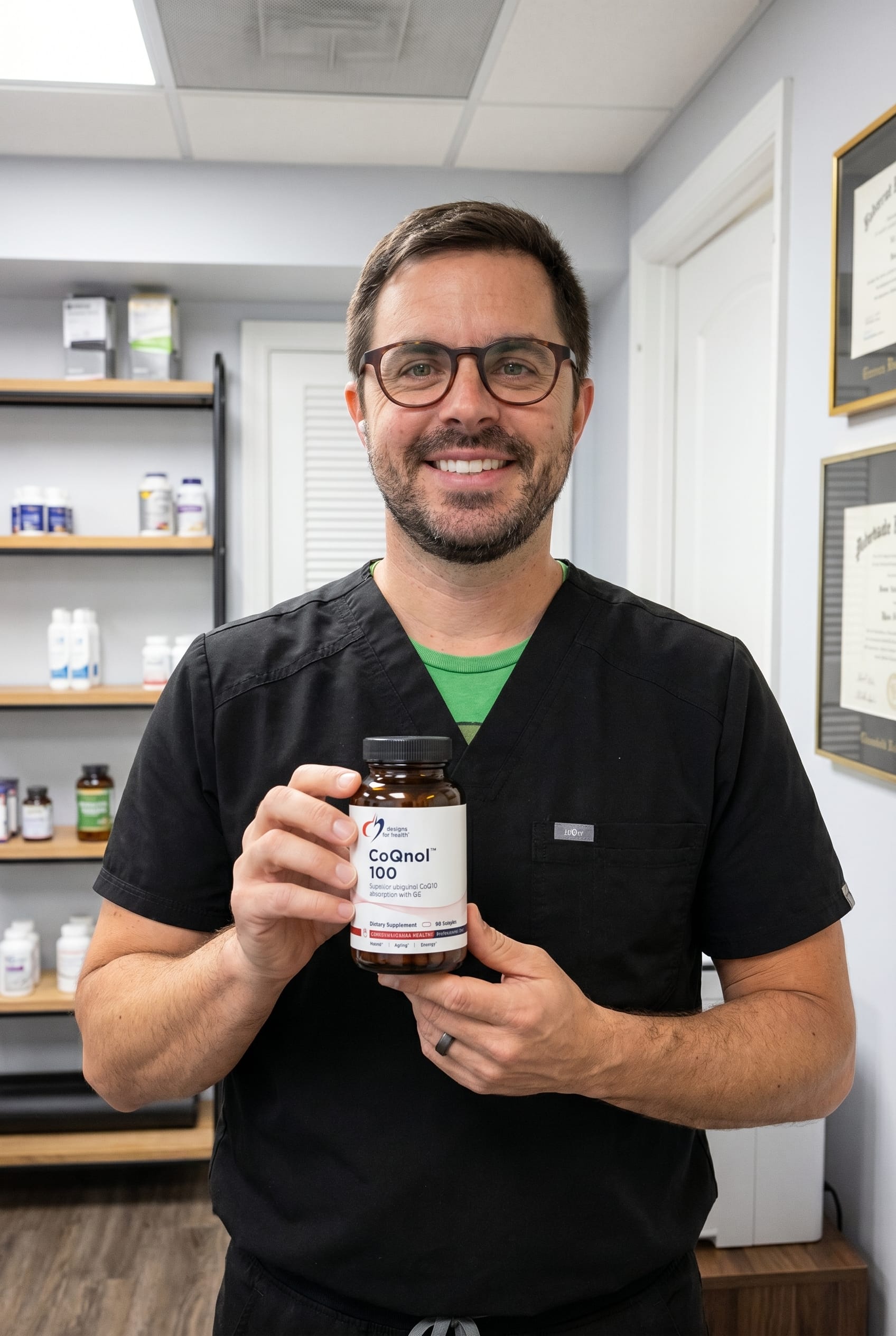
A 62-year-old retired electrician came to me after his cardiologist had added a statin to his routine three months earlier. The cholesterol numbers were excellent. The problem was that he could no longer get through his afternoon walk without his legs aching, and he had quit his weekly tennis game because his calves cramped up by the second set. His cardiologist had told him "muscle aches are pretty common, just push through." He did not want to push through. He wanted to feel like himself again.
I started him on CoQnol 100, one softgel a day with breakfast. Within three weeks the leg pain was noticeably better. By six weeks he was back on the tennis court. By two months he told me he had more energy in the afternoons than he had in years, and his wife had noticed. He stayed on the statin (it was the right call for his cardiac risk) and stayed on the CoQnol.
Statin-induced muscle pain is one of the most common reasons patients quit a medication they actually need. Ubiquinol replaces what the statin depletes, and for the right patient it changes the math entirely.
Quick verdict: CoQnol 100 is the ubiquinol product I reach for when patients are on a statin and dealing with muscle pain or fatigue, when adults over 40 are losing exercise tolerance for no obvious reason, when migraine prevention is needed, or when mild heart failure or mitral valve issues call for mitochondrial support.
Order CoQnol 100 →What this product is actually doing
CoQ10 (Coenzyme Q10) is a molecule your body makes that lives inside the mitochondria of every cell. It is essential for producing ATP, the energy currency the cell runs on. Tissues with the highest energy demand have the most CoQ10: the heart, the brain, the skeletal muscles, the kidneys, and the liver.
Two things deplete CoQ10. The first is age. Production drops every decade after about thirty, and by the time you are in your sixties your levels can be half of what they were at thirty. The second is statin medications. Statins block the enzyme that makes cholesterol, but the same enzyme is also the start of the pathway that makes CoQ10. When you knock down cholesterol with a statin, you knock down CoQ10 as a side effect. This is one of the leading explanations for statin-related muscle pain and fatigue.
CoQ10 exists in two forms in the body. Ubiquinone is the oxidized form. Ubiquinol is the reduced (active) form. Your body has to convert ubiquinone to ubiquinol before it can do its job in the mitochondria. That conversion gets less efficient as we age and in people with certain genetic variants. For patients over 40, for patients on statins, and for anyone with mitochondrial-related symptoms, starting with ubiquinol directly skips the conversion step.
CoQnol 100 is 100 mg of ubiquinol (the active form) in a small softgel taken with food. For most clinical situations this dose is right. For severe heart failure, post-MI recovery, or migraine prevention the dose may need to go higher (200 to 300 mg/day), but 100 mg is the workhorse dose for almost everyone else.
What is in CoQnol 100
Each softgel contains:
- Ubiquinol (Kaneka KH brand, the patented reduced form of CoQ10), 100 mg
- Carrier oils (medium-chain triglycerides and rice bran oil) for absorption
- Mixed tocopherols (vitamin E family) to stabilize the ubiquinol against oxidation
The Kaneka KH brand is worth calling out. CoQ10 and ubiquinol absorb poorly in dry powder form. They need a fat-soluble delivery system. The Kaneka softgel format is the most studied and best-absorbed form of ubiquinol on the market. Generic store-brand CoQ10 (especially ubiquinone in a hard tablet) often has very low bioavailability. The form matters.
100 mg is a clinical dose. The RDA-style "daily intake" suggestions for CoQ10 are much lower (30 mg) and barely move serum levels in most adults. Real-world doses for symptom relief usually start at 100 mg/day and go up from there in heart failure, statin myopathy, and migraine prevention.
Who tends to do well on CoQnol 100
The pattern that responds best:
- Patients on a statin medication (atorvastatin, rosuvastatin, simvastatin, etc.) with muscle pain, weakness, or fatigue
- Statin patients who want to prevent muscle symptoms before they start
- Adults over 40 with general fatigue and reduced exercise tolerance
- Mild to moderate heart failure (under cardiologist supervision)
- Migraine prevention (CoQ10 has good evidence in this setting)
- Post-cardiac event recovery
- High blood pressure that has not responded fully to medication
- Patients with mitral valve prolapse, palpitations, or unexplained fatigue with a normal cardiac workup
- Athletes and high training volume in middle age
- People with fibromyalgia or chronic fatigue patterns
- Pre-conception support for fertility (especially egg quality in women over 35)
- Periodontal disease (CoQ10 plays a role in gum tissue energy metabolism)
Who should skip it
- Patients on warfarin (CoQ10 can reduce the effectiveness of warfarin; talk to your prescriber if you need to add it)
- People taking chemotherapy drugs whose mechanism depends on oxidative stress (CoQ10 is an antioxidant and could theoretically blunt the drug; check with oncology)
- Pregnant or nursing women without their prescriber's input
- People taking blood pressure medications who already run low (CoQ10 can mildly lower blood pressure)
- Anyone with allergy to the carrier oils
- Patients with very low cholesterol (it is a clue something else is going on; address the underlying cause)
Set Up Autoship for CoQnol 100
If you take this regularly, set up DFH's Autoship and you get an extra discount on top of practitioner pricing, plus free shipping every time. Cancel or change the schedule any time. Set it and forget it.
Start Autoship →How to take it
One softgel a day with a meal that contains some fat. CoQ10 is fat-soluble and absorbs three to five times better with a meal that contains 5 to 10 grams of fat. Breakfast with eggs, oatmeal with butter, or a sandwich with olive oil dressing is plenty.
Timing: morning or midday is fine. CoQ10 is not stimulating for most people, but a few patients feel a small energy boost and would rather take it earlier in the day.
For statin patients with active muscle symptoms, one softgel a day is the starting dose. If symptoms persist after 6 to 8 weeks, the dose can go to two softgels (200 mg) a day under your prescriber's care.
For heart failure: dosing is usually higher (200 to 300 mg/day or more, in divided doses) and should be coordinated with your cardiologist. This is not a do-it-yourself situation.
For migraine prevention: 100 to 300 mg/day in divided doses for at least 3 months to assess response.
For general age-related decline (over 50, fatigue, reduced exercise tolerance): 100 mg a day is the default.
What to expect
- Days 1 to 7: most patients do not feel a dramatic change yet. Some feel slightly more energy within days.
- Weeks 2 to 4: statin-related muscle pain often eases. Exercise tolerance starts to come back.
- Weeks 4 to 8: full mitochondrial effect. Patients with heart failure may feel less fatigue, less shortness of breath on exertion.
- 2 to 3 months: migraine frequency drops in responders. Blood pressure may settle slightly lower.
- If you stop: the depletion effect from statins or aging resumes. Symptoms can return within weeks to months.
Side effects
- Very well tolerated. CoQ10 has one of the best safety profiles in supplement medicine.
- Mild stomach upset if taken without food. Always take with a meal.
- Insomnia in a small number of patients who take it close to bedtime. Move the dose to morning.
- Loose stool or mild nausea, rare
- Headache, rare
- Drug interactions: warfarin (reduced effect), some chemotherapy drugs, blood pressure medications (modest additive effect)
What I do not love about it
The capsule is fairly small but greasy on the outside, and some patients with delicate stomachs find it slips down better with a full glass of water. Not a real complaint, just a packaging note.
Cost is the bigger issue. Real-quality ubiquinol (Kaneka KH or equivalent) is genuinely more expensive than generic CoQ10. Patients who do not need ubiquinol specifically (younger patients, no statin, no major cardiovascular issue) can sometimes do well on a less expensive ubiquinone product. But for the populations I described above, the price premium for ubiquinol is justified by better absorption and faster symptom relief.
For severe heart failure, 100 mg is not enough. The Q-SYMBIO trial that showed mortality benefit used 300 mg/day in divided doses. Patients in that situation should be on a higher dose under cardiologist supervision, often using CoQnol 200 (the same formula at 200 mg/softgel) or doubling up on the 100 mg.
For broader CoQ10 background, the NIH Office of Dietary Supplements fact sheet on CoQ10 covers the major studies, and the PMC review on CoQ10 and statin-associated muscle symptoms covers the statin question specifically.
Bottom line
CoQnol 100 is the ubiquinol product I reach for when patients are on a statin and dealing with muscle pain or fatigue, when adults over 40 are losing exercise tolerance for no obvious reason, when migraine prevention is needed, or when mild heart failure or mitral valve issues call for mitochondrial support. The Kaneka KH ubiquinol form bypasses the age- and statin-related conversion bottleneck, and 100 mg a day with a meal is the right dose for almost everyone outside of heart failure. One softgel a day with breakfast, for at least 6 to 8 weeks to assess response.
Always check with a healthcare provider before starting any new supplement, especially if you take warfarin, chemotherapy, or blood pressure medications.
← See all cardiovascular health reviews by Dr. Bell
Ready to try CoQnol 100?
It is one I trust enough to use with my own patients and order for my family. Through my DFH store you get the authentic, direct-from-manufacturer product with practitioner pricing applied automatically at checkout.
Order CoQnol 100 →Authentic, direct from Designs for Health · practitioner pricing · no third-party counterfeits
About the Author: Dr. Bell
Dr. Bell is a chiropractor and holistic wellness practitioner at Dr. Bell Health. He writes plain-language reviews of Designs for Health supplements based on years of clinical experience. Read more about Dr. Bell.