DopaBoost Review by Designs for Health - Dr. Bell
Designs for Health DopaBoost review by Dr. Bell. A focused dopamine-support formula using L-tyrosine, mucuna pruriens (a natural L-dopa source), and supporting nutrients for focus, motivation, and a healthy reward response. Dosing, who benefits, side effects, and important medication interactions.

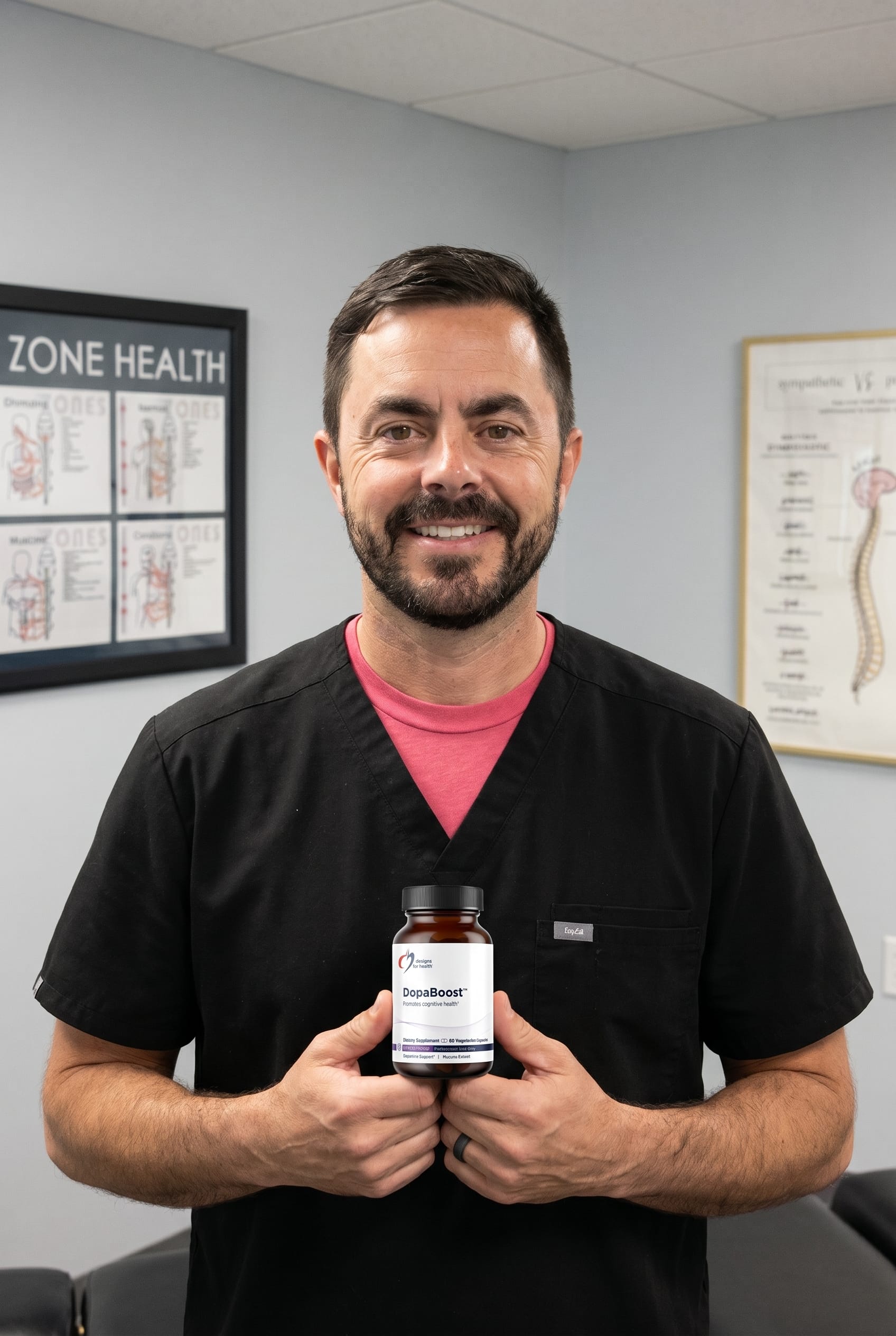
A 45-year-old man came to me describing a slump that did not fit any of the obvious diagnoses. He was not depressed in the clinical sense; he just felt flat, low on motivation, and unable to muster the focus and drive he used to have for his work and his hobbies. His sleep was fine, his labs were normal, and his doctor had ruled out the usual culprits. He described it as "the spark is gone" and asked whether there was something he could do at the brain-chemistry level to support his motivation and focus, ideally without a stimulant.
This is a great use case for a dopamine-focused approach. Dopamine is the brain's motivation, focus, and reward signal; it is what tells you something is worth getting up and doing. When dopamine signaling is low, people feel exactly what he described: flat, unmotivated, foggy, and unable to summon the drive for things they used to enjoy. Supporting dopamine production with the right precursors and cofactors is a sensible, non-stimulant way to help that picture. I talked him through it and started him on DopaBoost.
The strength of DopaBoost is that it goes after dopamine from two angles at once, and I will explain that below. Over a few weeks of consistent use, he noticed steadier morning focus, more genuine motivation for his work, and a sense that his drive was coming back online. A dopamine-support supplement is not an antidepressant and it is not appropriate for everyone, but for the right person it can be a useful, non-stimulant tool. DopaBoost is the focused dopamine support formula I reach for.
Quick verdict: DopaBoost is the focused dopamine-support formula I reach for when someone feels flat and low on motivation, with the medical causes ruled out, and they want non-stimulant brain-chemistry support.
Order DopaBoost →What this product is actually doing
Dopamine is one of the most important messengers in the brain. It drives motivation, focus, the ability to start tasks and stick with them, and the sense of reward you get from doing things that matter. When dopamine signaling is robust, you feel motivated and engaged; when it is low, things that used to feel rewarding now feel meh, and even simple tasks can feel like they take more push than they should.
DopaBoost is built to support the body's own production of dopamine, rather than to stimulate the system with caffeine or other stimulants. The body makes dopamine in a two-step path: an amino acid called tyrosine is converted into L-dopa, and L-dopa is then converted into dopamine. The formula goes after both steps at once, by providing the upstream amino acid (tyrosine) and by also providing a natural source of L-dopa directly (from the seed of a plant called mucuna pruriens, which is one of the best-known natural sources of L-dopa).
It does this with a focused blend of those two dopamine precursors plus the cofactors the brain needs to actually do the conversions. The active form of vitamin B6 in particular is a critical spark plug for turning L-dopa into dopamine, so its inclusion makes the precursors more useful. It is a small, sensible, upstream-focused formula aimed at one job: supporting the brain's own dopamine production.
What is in DopaBoost
The formula is a focused, two-angle dopamine support blend:
- L-tyrosine (the amino acid the body uses upstream to build dopamine)
- Mucuna pruriens extract (standardized for L-dopa content; a natural source of dopamine's direct precursor)
- Vitamin B6 (as pyridoxal-5-phosphate) (the active form of B6, a key cofactor for converting L-dopa to dopamine)
- Supporting cofactors (additional nutrients the dopamine pathway depends on)
The defining feature is the two-angle approach. By including both L-tyrosine (the upstream amino acid) and mucuna (a natural L-dopa source), the formula supports dopamine production from both the upstream and downstream sides of the pathway. The active form of B6 is included for a real reason: it is the cofactor the conversion needs. This is not a kitchen-sink mix; it is a small, intentional blend.
Who tends to do well on DopaBoost
The pattern that responds best:
- People who feel flat, unmotivated, and low on drive (with depression ruled out by their provider)
- Those struggling with focus, follow-through, and the ability to start tasks
- People who feel that things that used to be rewarding now feel meh
- Those who want non-stimulant support for focus and motivation, rather than more caffeine
- People interested in supporting dopamine from the upstream side (precursors and cofactors)
- Adults in midlife who notice their drive is not what it was, in the absence of any clear medical cause
Who should skip it
- Anyone with Parkinson's disease or on L-dopa, carbidopa, MAOIs, or other dopamine-modulating prescription medication, without specialist input
- People on antipsychotic medication or with a history of psychosis or schizophrenia
- Those on antidepressants, without provider guidance (interactions are possible)
- People with bipolar disorder, without provider input (dopamine support can affect mood states)
- Pregnant or breastfeeding women (mucuna is generally avoided in pregnancy)
- Anyone with melanoma or a history of it (mucuna and L-dopa are typically avoided)
- Those with significant cardiovascular disease, without provider input
Save on DopaBoost with Practitioner Pricing
Below standard retail with practitioner pricing applied to every order. No memberships, no minimums, no hoops to jump through. Just direct-from-DFH shipping with my practitioner discount built into the price.
Get DopaBoost →How to take it
Take it earlier in the day, away from protein meals.
- Take the label dose in the morning and/or early afternoon, since dopamine support is the wrong direction late in the day.
- Take it on a relatively empty stomach and away from protein meals; the amino acids in protein compete with tyrosine and L-dopa for absorption into the brain.
- Start at the lower end of the dose range to see how you respond; the effect is real, and people vary in sensitivity.
- Use it as an as-needed or short-course tool more often than something taken every day forever; periodic breaks are sensible.
- Pair it with the basics that genuinely support dopamine: real exposure to morning light, regular exercise, adequate sleep, meaningful work and connection, and limiting the cheap, high-frequency dopamine hits (excess screens, scrolling, junk-food rewards) that blunt the system.
What to expect
- Often fairly quickly: many people notice better focus, more motivation, and a sense of engagement returning within days to a couple of weeks
- The effect is brain-chemistry support, not the buzz of a stimulant
- It is best as a tool, not a permanent crutch; reassess periodically
- Best paired with the lifestyle pieces that build dopamine naturally
Side effects
- Generally well tolerated at sensible doses
- Possible mild nausea, headache, or insomnia (especially if taken late in the day)
- Mild stimulating effect in sensitive people; back off the dose if it feels too much
- Serious interaction potential with Parkinson's medication, antidepressants, antipsychotics, and other dopamine- or serotonin-modulating drugs
What I do not love about it
The medication-interaction caution is the one I always lead with, and it is a real one. The mucuna in this product contains L-dopa, which is the same molecule used as the gold-standard medication for Parkinson's disease. For anyone on Parkinson's medication, antidepressants (especially MAOIs), antipsychotics, or any other drug that modulates dopamine or serotonin, this product can interact in serious ways and must not be added without specialist input. It is also typically avoided in people with a history of psychosis or schizophrenia, where boosting dopamine can be the wrong direction. I never have someone quietly stack this with psychiatric medication.
I am also honest that "low motivation" deserves a real look before reaching for a dopamine supplement. The pattern can come from depression, thyroid problems, low testosterone, poor sleep, chronic stress, burnout, alcohol use, recreational drug use, or simply a life that has become unrewarding by design. Any of those are better addressed at the root than overridden with a supplement. I want people to have ruled out depression with their provider, checked the obvious labs, and looked honestly at sleep, stress, and lifestyle before treating "I feel flat" as a dopamine problem.
And the dopamine system has its own logic. Modern life floods the brain with cheap dopamine hits all day (scrolling, junk food, slot-machine notifications), and the system adapts by becoming less responsive, which is part of why people feel flat. No supplement undoes that on its own. Real motivation and engagement come back when people pair sensible dopamine support with the boring foundations: morning light, exercise, sleep, meaningful work, real connection, and trimming the cheap hits that are draining the system. I use DopaBoost as a tool in that broader project for the right person, with their provider in the loop, never as a stand-alone substitute for the rest of the work.
For background, see the PMC review on mucuna pruriens and L-dopa, the PMC review on tyrosine, dopamine, and cognitive performance, and the NIH NINDS overview of Parkinson's disease (for context on L-dopa medication).
Bottom line
DopaBoost is the focused dopamine-support formula I reach for when someone feels flat and low on motivation, with the medical causes ruled out, and they want non-stimulant brain-chemistry support. It pairs L-tyrosine with mucuna pruriens (a natural source of L-dopa) and the active form of B6, going after dopamine production from two angles at once. Take it earlier in the day, away from protein, in short courses rather than indefinitely, and pair it with the lifestyle pieces that actually build dopamine: light, exercise, sleep, and meaningful engagement.
Always check with a healthcare provider before starting any new supplement, and absolutely if you take Parkinson's medication, antidepressants (especially MAOIs), antipsychotics, have bipolar disorder, a history of psychosis or melanoma, or are pregnant or breastfeeding.
← See all stress, mood and sleep reviews by Dr. Bell
Ready to try DopaBoost?
It is one I trust enough to use with my own patients and order for my family. Through my DFH store you get the authentic, direct-from-manufacturer product with practitioner pricing applied automatically at checkout.
Order DopaBoost →Authentic, direct from Designs for Health · practitioner pricing · no third-party counterfeits
About the Author: Dr. Bell
Dr. Bell is a chiropractor and holistic wellness practitioner at Dr. Bell Health. He writes plain-language reviews of Designs for Health supplements based on years of clinical experience. Read more about Dr. Bell.