Fiber Prebiotic Complete Review by Designs for Health - Dr. Bell
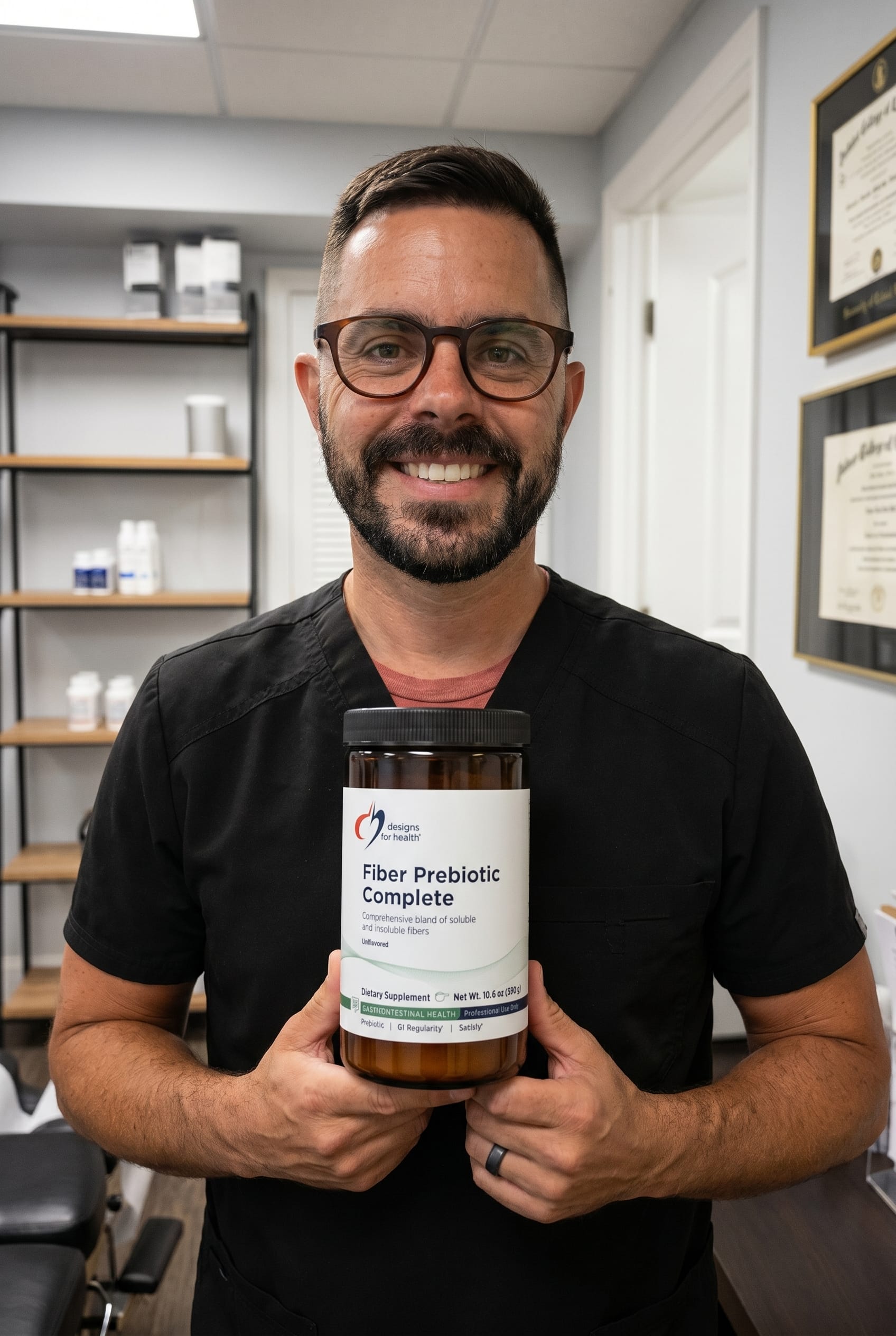
Designs for Health Fiber Prebiotic Complete (formerly PaleoFiber) review by Dr. Bell. Multi-source soluble and insoluble fiber blend for GLP-1 support, satiety, blood sugar control, regularity, and gut microbiome health. Dosing, who benefits, side effects.

A 52-year-old patient came to me three months into a GLP-1 medication for weight management. She had lost 22 pounds and was happy with the result, but the side effects had become a daily problem. She was constipated, her appetite was so suppressed she was sometimes eating only 600 calories a day, and her gastroenterologist had warned her that her gut bacteria were almost certainly being affected by the very low food intake. Her stool had become hard and infrequent. She wanted a way to support her gut without abandoning the medication that was finally helping her metabolism.
I started her on Fiber Prebiotic Complete, one scoop in water every morning with breakfast, and one scoop again with dinner if she could tolerate it. Within ten days her bowel movements were daily and well-formed. Within four weeks her appetite had improved enough that she was eating in the 1,200 to 1,400 calorie range, which was sustainable. Her gastroenterologist's follow-up labs showed her short-chain fatty acid markers were back in a healthier range.
Fiber is the most under-used tool in modern nutrition. Most Americans get 12 to 15 grams a day; the research-backed range for metabolic and gut health is 30 to 40 grams. The gap matters more on GLP-1 medications, where appetite suppression makes it almost impossible to get enough fiber from food alone. Fiber Prebiotic Complete (formerly PaleoFiber) is the broad-spectrum fiber blend I reach for when patients need to close that gap quickly.
Quick verdict: Fiber Prebiotic Complete is the broad-spectrum fiber blend I reach for when patients need to close the modern fiber gap quickly, especially on GLP-1 medications where constipation and microbiome starvation are nearly universal.
Order Fiber Prebiotic Complete →What this product is actually doing
Dietary fiber is not one thing. There are dozens of distinct fibers and resistant starches in real food, each with different effects in the gut. Some are soluble and form a gel that slows digestion and steadies blood sugar. Some are insoluble and add bulk to stool. Some are fermentable by gut bacteria into short-chain fatty acids that feed the colon lining and signal satiety hormones (including GLP-1). A few are mucilaginous and soothe the gut wall directly.
A single-source fiber supplement (psyllium alone, for example) only hits one or two of these pathways. Fiber Prebiotic Complete blends 12 fiber sources, which means every type of beneficial fiber gets represented and gut bacteria get a diverse substrate to work with. Diversity is what the modern microbiome is starved for.
For patients on GLP-1 medications, the fiber does double duty. It produces short-chain fatty acids that stimulate the body's own GLP-1 release, which means you keep the natural signaling pathway active while the medication is working. It also addresses the constipation that is almost universal on these drugs, and it feeds the gut bacteria that the medication-induced low food intake is starving.
What is in Fiber Prebiotic Complete
Each scoop (about 12 grams of powder, 7 grams of total fiber) contains a blend of:
- Acacia gum (soluble, gentle, well-tolerated)
- Inulin from chicory root (prebiotic; feeds Bifidobacterium)
- Apple pectin (soluble, supports stool consistency)
- Citrus pectin (gentle, demulcent)
- Carrot fiber (insoluble, adds bulk)
- Beet fiber (insoluble + some prebiotic activity)
- Cellulose (insoluble bulk)
- Flax seed powder (soluble and insoluble, plus lignans for hormonal balance)
- Glucomannan (konjac) (highly soluble; gel-forming; satiety)
- Larch arabinogalactan (prebiotic + immune support)
- Psyllium husk (soluble, classic stool former)
- Plum (prune) fiber (gentle motility support)
The combination delivers 7 grams of total fiber per scoop, including about 4 grams of soluble fiber and 3 grams of insoluble. Two scoops a day gets you to 14 grams from this product, which is roughly half the daily fiber goal. The rest should still come from food (vegetables, beans, whole grains, berries) wherever possible.
The powder is unflavored. It mixes into water, smoothies, plain yogurt, or oatmeal without much taste change. Some patients add a small squeeze of lemon or a half teaspoon of unsweetened cocoa to take any neutral edge off.
Who tends to do well on Fiber Prebiotic Complete
The pattern that responds best:
- Patients on GLP-1 medications (semaglutide, tirzepatide, liraglutide) with constipation and reduced food intake
- Patients trying to lose weight without a GLP-1 (fiber boosts satiety meaningfully)
- Pre-diabetes and type 2 diabetes with elevated post-meal glucose
- Chronic constipation, slow-transit constipation, or irregular bowels
- IBS with constipation (IBS-C) or mixed IBS
- High LDL cholesterol or unfavorable cholesterol ratios (soluble fiber binds bile acids and lowers LDL)
- Diverticular disease (in remission)
- Patients with low fiber intake and a typical Western diet
- Mid-life hormonal patterns where lignan-rich flax helps with estrogen metabolism
- Anyone with elevated hs-CRP looking for a low-cost anti-inflammatory baseline
- Post-antibiotic gut recovery (often paired with a probiotic)
- Bariatric surgery patients who cannot reach fiber goals through food
Who should skip it
- Severe gastroparesis or other major motility disorders (talk to your prescriber first)
- Active diverticulitis flare (wait until the flare has resolved before adding fiber)
- Severe IBS-D where added fiber worsens diarrhea (some types of soluble fiber can help; some make it worse)
- Patients on the lowest-residue diet for medical reasons (Crohn's flare, prep for procedure)
- People with severe ragweed/birch pollen allergy (inulin from chicory cross-reactivity)
- Severe swallowing problems (the powder thickens slightly in water and could be a risk)
- Patients with severe SIBO (small intestine bacterial overgrowth) may flare on prebiotic fibers; wait until SIBO is treated
- Bowel obstruction history without their gastroenterologist's input
I Trust DFH for My Own Patients
I send my own patients to Designs for Health for Fiber Prebiotic Complete because I trust their formulations, sourcing, and quality control. When you order through my DFH store, you get the same direct-from-manufacturer authenticity I get for my own family, with practitioner pricing applied automatically.
Order Fiber Prebiotic Complete →How to take it
Start low and go slow. The fiber load shocks the gut if you go from 12 grams a day to 30 grams in one week. Increase gradually:
- Week 1: one half scoop a day in 12 ounces of water, taken with breakfast
- Week 2: one scoop a day with breakfast
- Week 3 and beyond: one scoop with breakfast and one with dinner
Mix with at least 12 ounces of water. Drink another 8 to 12 ounces over the next hour. Fiber without water can actually worsen constipation by absorbing the small amount of water already in the colon.
For GLP-1 patients specifically: take one scoop in the morning, ideally 30 to 60 minutes before the first meal. The gel helps with appetite control and slows gastric emptying, both of which align with how the medication works.
Take fiber at least 2 hours away from prescription medications. Soluble fiber can bind some medications (especially thyroid medication, lithium, and certain antibiotics) and reduce their absorption.
What to expect
- Days 1 to 5: bowel movements may shift in consistency. Some patients notice mild gas or bloating as gut bacteria adjust. Reduce the dose if it is too much.
- Weeks 2 to 4: bowels become more regular and well-formed. Satiety improves. Blood sugar after meals often stabilizes.
- Weeks 4 to 8: gut microbiome diversity often improves on stool testing. LDL cholesterol drops modestly. Skin sometimes clears.
- 3 to 6 months: full integration. Patients who used to feel hungry constantly often eat less without trying.
- If you stop: bowels typically slow within a few days. The metabolic benefits fade over a few weeks.
Side effects
- Mild gas and bloating in the first week. Usually resolves as the gut adjusts.
- Loose stool if dosed too high or with too little water
- Constipation paradoxically, if water intake is too low
- Fullness and reduced appetite (sometimes a feature, sometimes a bug)
- Possible reduced absorption of medications taken at the same time
- Allergic reaction in patients with severe ragweed/birch allergies (chicory inulin)
- Bezoar risk in patients with severe gastroparesis (rare)
What I do not love about it
It is a powder, not a capsule. Some patients prefer capsules, but you cannot deliver this much fiber in a capsule that anyone would actually take. The powder is the right form factor for the dose.
For patients with active SIBO, the prebiotic content (inulin, larch arabinogalactan) can flare symptoms by feeding the wrong bacteria in the wrong place. I usually treat SIBO first, then introduce this product during the rebuild phase.
And: fiber is one part of the GLP-1 support toolkit, not the whole thing. GLP-1 patients also benefit from adequate protein (often a protein powder is needed), electrolytes, omega-3, and sometimes a B-vitamin complex. Fiber is foundational but not sufficient on its own.
For background, see the PMC review on dietary fiber and metabolic health, the PMC review on short-chain fatty acids and the GLP-1 axis, and the NIH NCCIH summary on probiotics and prebiotics.
Bottom line
Fiber Prebiotic Complete is the broad-spectrum fiber blend I reach for when patients need to close the modern fiber gap quickly, especially on GLP-1 medications where constipation and microbiome starvation are nearly universal. The 12-source blend covers soluble, insoluble, prebiotic, and mucilaginous fibers in one scoop. Start with a half scoop, work up to two scoops a day, take with plenty of water and at least 2 hours away from prescription medications.
Always check with a healthcare provider before starting any new supplement, especially if you have gastroparesis, active diverticulitis, severe SIBO, or take medications that bind to fiber.
← See all GLP-1 support reviews by Dr. Bell
Ready to try Fiber Prebiotic Complete?
It is one I trust enough to use with my own patients and order for my family. Through my DFH store you get the authentic, direct-from-manufacturer product with practitioner pricing applied automatically at checkout.
Order Fiber Prebiotic Complete →Authentic, direct from Designs for Health · practitioner pricing · no third-party counterfeits
About the Author: Dr. Bell
Dr. Bell is a chiropractor and holistic wellness practitioner at Dr. Bell Health. He writes plain-language reviews of Designs for Health supplements based on years of clinical experience. Read more about Dr. Bell.