GlucoSupreme Herbal Review by Designs for Health - Dr. Bell
Designs for Health GlucoSupreme Herbal review by Dr. Bell. Berberine, banaba, alpha-lipoic acid, cinnamon, gymnema, and chromium for blood sugar, insulin resistance, pre-diabetes, and metabolic and GLP-1 support. Dosing, who benefits, side effects.

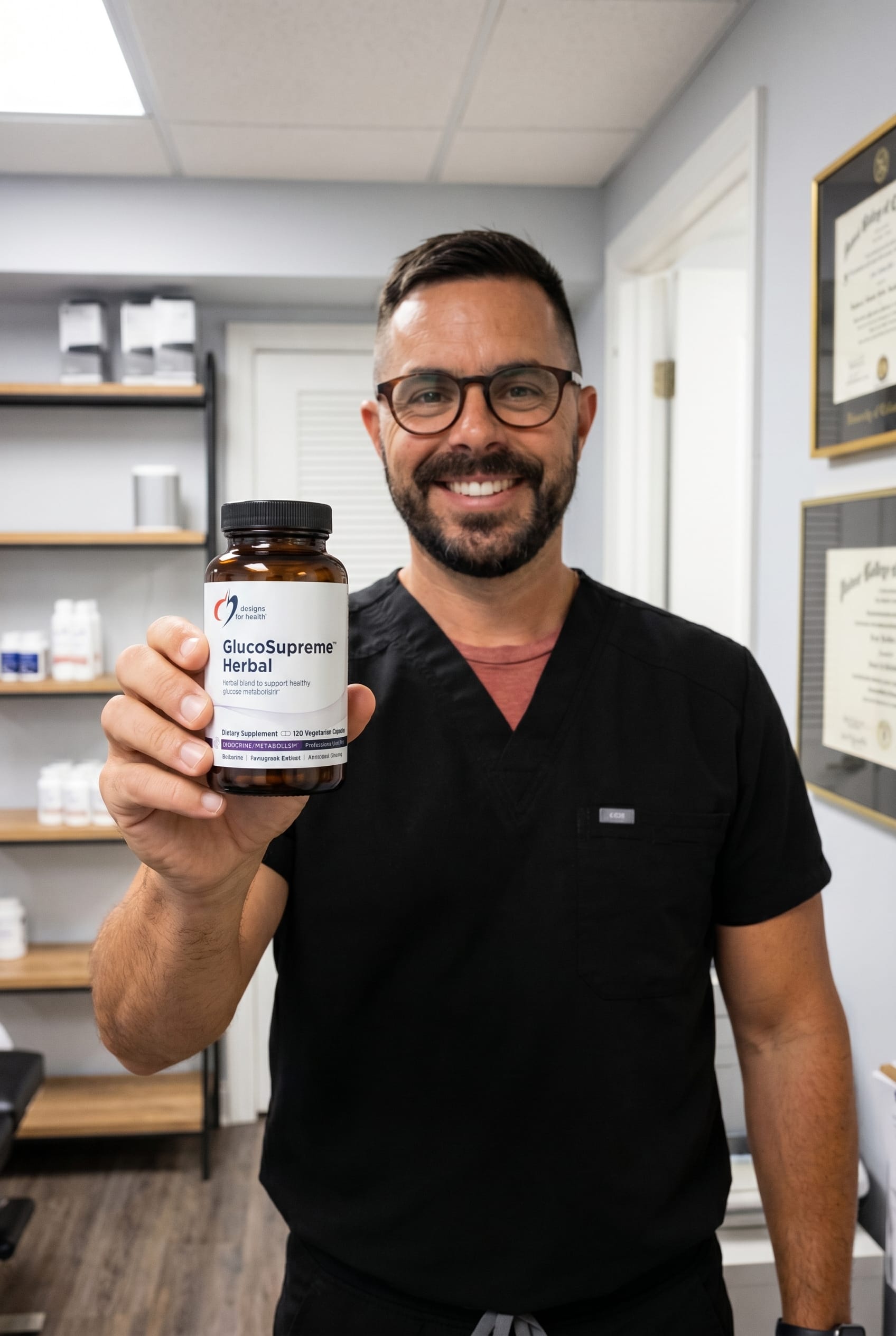
A 47-year-old man came to me with a fasting glucose of 112 and an A1C of 6.0, right at the line between normal and pre-diabetes. His doctor had told him to lose weight and come back in six months. He was motivated but discouraged, because he had been trying to eat better for a year and the number on the lab sheet kept creeping up anyway. He did not want to start a prescription medication if he could avoid it, but he also did not want to wait passively for full diabetes to arrive.
I started him on GlucoSupreme Herbal, one capsule twice a day with his two largest meals, alongside a few specific food changes (protein and vegetables first, refined carbohydrate last, a ten-minute walk after dinner). At his three-month recheck his fasting glucose was 96 and his A1C had come down to 5.6. He had also lost eleven pounds, mostly because the post-meal energy crashes that used to send him to the vending machine had stopped.
Blood sugar problems are the quiet epidemic of modern life. Roughly one in three American adults has pre-diabetes, and most of them do not know it. The window between "your numbers are creeping up" and "you have type 2 diabetes" is exactly where the right combination of diet, movement, and targeted supplementation can change the trajectory. GlucoSupreme Herbal is the botanical blend I reach for in that window.
Quick verdict: GlucoSupreme Herbal is the botanical blood sugar blend I reach for in the pre-diabetes and insulin resistance window, and as an adjunct in type 2 diabetes and PCOS under supervision.
Order GlucoSupreme Herbal →What this product is actually doing
Insulin is the hormone that moves sugar out of your blood and into your cells. When you eat refined carbohydrate over and over for years, your cells stop responding to insulin as well as they should. This is insulin resistance. Your pancreas compensates by making more insulin, your blood sugar stays normal for a while, and then eventually the system can no longer keep up and your glucose starts to climb.
GlucoSupreme Herbal works on several points in that chain at once. Some ingredients help your cells respond to insulin again. Some slow the breakdown of carbohydrate in the gut so the sugar enters your blood more gently. Some support the mitochondria that burn glucose for energy. The point of a blend rather than a single herb is that blood sugar control is not one mechanism, so attacking it from several angles tends to work better than relying on any one compound.
This matters for GLP-1 patients too. Many people on semaglutide or tirzepatide still have meaningful insulin resistance underneath the appetite suppression, and a botanical blend like this can support the metabolic repair the medication is trying to enable. It is not a replacement for the medication; it is a complement to the broader metabolic work.
What is in GlucoSupreme Herbal
The blend is built around well-studied blood sugar botanicals and minerals:
- Berberine HCl (the headline ingredient; activates an enzyme called AMPK that improves how cells take up and use glucose)
- Banaba leaf extract (standardized for corosolic acid, which supports glucose transport into cells)
- Alpha-lipoic acid (an antioxidant that supports insulin sensitivity and nerve health)
- Cinnamon bark extract (helps blunt post-meal glucose spikes)
- Gymnema sylvestre (a leaf extract traditionally used to reduce sugar cravings and support pancreatic function)
- Chromium (a trace mineral that is a cofactor for insulin signaling)
Berberine is the star here. The research on berberine for blood sugar is genuinely impressive, with several head-to-head trials showing effects in the same neighborhood as metformin for glucose and A1C, though berberine is not a drug and should not be treated as a one-for-one substitute. Pairing it with banaba, alpha-lipoic acid, cinnamon, gymnema, and chromium covers the supporting mechanisms that berberine alone does not.
Who tends to do well on GlucoSupreme Herbal
The pattern that responds best:
- Pre-diabetes (fasting glucose 100 to 125, or A1C 5.7 to 6.4)
- Insulin resistance and metabolic syndrome
- Type 2 diabetes (as an adjunct, under medical supervision)
- Polycystic ovary syndrome (PCOS), where insulin resistance is a driver
- Post-meal energy crashes and afternoon slumps
- Sugar and refined-carbohydrate cravings
- People on GLP-1 medications who still have insulin resistance underneath
- Stubborn belly fat with normal or borderline labs
- Elevated triglycerides alongside blood sugar issues
- Fatty liver associated with metabolic syndrome
Who should skip it
- Pregnant or breastfeeding women (berberine is not considered safe in pregnancy)
- Anyone on a blood-sugar-lowering medication without prescriber supervision (risk of hypoglycemia)
- People taking medications metabolized by the liver's CYP3A4 pathway (berberine can raise drug levels; check with a pharmacist)
- Those on cyclosporine or other transplant medications
- Anyone with a history of low blood sugar episodes
- People scheduled for surgery within two weeks (stop beforehand, as it affects blood sugar)
Set Up Autoship for GlucoSupreme Herbal
If you take this regularly, set up DFH's Autoship and you get an extra discount on top of practitioner pricing, plus free shipping every time. Cancel or change the schedule any time. Set it and forget it.
Start Autoship →How to take it
Berberine has a short half-life, which is why it works best taken with meals two or three times a day rather than all at once. A typical approach:
- Start with one capsule once a day with your largest meal for the first week, to check tolerance
- Move to one capsule twice a day with your two largest meals
- Some patients with more significant insulin resistance use one capsule three times a day, with each main meal, under a provider's guidance
Take it with food. Taking berberine on an empty stomach is the fastest way to get the cramping and loose stool that gives the ingredient its reputation. With food, most people tolerate it well.
Give it a full eight to twelve weeks before you judge it, and recheck your fasting glucose and A1C. A1C reflects a roughly three-month average, so it cannot move faster than that.
What to expect
- Week 1 to 2: some people notice steadier energy and fewer cravings; some notice nothing yet
- Weeks 3 to 6: post-meal energy crashes ease, afternoon slumps soften, sugar cravings often drop
- Weeks 8 to 12: fasting glucose typically trends down; A1C starts to reflect the change
- 3 to 6 months: full effect on A1C; many patients also see modest weight loss and lower triglycerides
- If you stop: the blood sugar benefits fade over a few weeks, especially without the diet and movement changes
Side effects
- Digestive upset from berberine: cramping, gas, loose stool or constipation, especially early or on an empty stomach
- Low blood sugar if combined with diabetes medication (watch for shakiness, sweating, lightheadedness)
- A metallic or bitter taste from the berberine in some people
- Rare headache early on
- Drug interactions through the CYP3A4 liver pathway
What I do not love about it
It is two to three capsules a day with meals, and the multi-dose schedule is the part patients forget. A once-a-day pill would be easier to stick with, but berberine's short half-life means once a day simply does not hold blood sugar steady the way split dosing does. The schedule is a feature of the chemistry, not a flaw in the product.
Berberine also interacts with a meaningful number of prescription medications. This is not a "grab it off the shelf and start" supplement for anyone on multiple drugs. It deserves a conversation with your prescriber or pharmacist first, especially if you are already on something for blood sugar.
And to be clear about what it is: this is a powerful support for diet and lifestyle change, not a substitute for it. The patients who do best pair it with real food changes and daily movement. The ones who expect a capsule to undo a high-sugar diet are usually disappointed.
For background, see the PMC trial comparing berberine and metformin in type 2 diabetes, the PMC review of alpha-lipoic acid and insulin sensitivity, and the NIH NCCIH summary on diabetes and dietary supplements.
Bottom line
GlucoSupreme Herbal is the botanical blood sugar blend I reach for in the pre-diabetes and insulin resistance window, and as an adjunct in type 2 diabetes and PCOS under supervision. The berberine base plus banaba, alpha-lipoic acid, cinnamon, gymnema, and chromium covers the major mechanisms of glucose control. Take it with your largest meals, two to three times a day, give it a full three months, and recheck your labs.
Always check with a healthcare provider before starting any new supplement, especially if you are pregnant, take blood-sugar or other prescription medications, or have surgery scheduled.
← See all GLP-1 support reviews by Dr. Bell
Ready to try GlucoSupreme Herbal?
It is one I trust enough to use with my own patients and order for my family. Through my DFH store you get the authentic, direct-from-manufacturer product with practitioner pricing applied automatically at checkout.
Order GlucoSupreme Herbal →Authentic, direct from Designs for Health · practitioner pricing · no third-party counterfeits
About the Author: Dr. Bell
Dr. Bell is a chiropractor and holistic wellness practitioner at Dr. Bell Health. He writes plain-language reviews of Designs for Health supplements based on years of clinical experience. Read more about Dr. Bell.