Liposomal Vitamin C Review by Designs for Health - Dr. Bell
Designs for Health Liposomal Vitamin C review by Dr. Bell. Liposome-encapsulated vitamin C for higher absorption without the stomach upset of high-dose tablets, supporting immune health, collagen, and antioxidant defense. Dosing, who benefits, side effects.

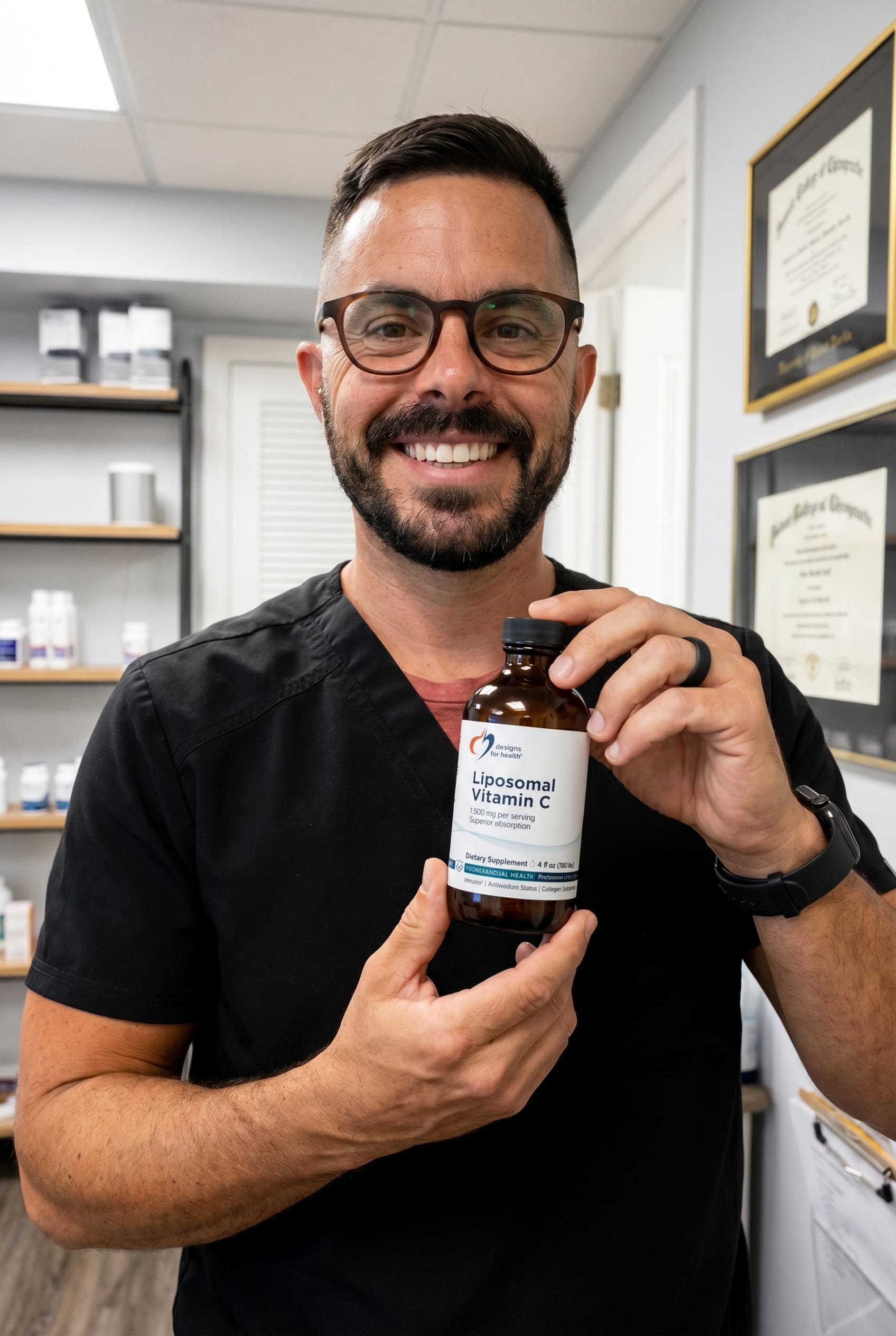
A 50-year-old man came to me frustrated. Every winter he tried to take high-dose vitamin C to support his immune system, and every time the large doses gave him stomach cramps and loose stools before he ever got to the amount he was aiming for. He had concluded his body just could not handle much vitamin C, and he wanted to know if there was a way around the gut limit.
There is, and it comes down to how the vitamin C is delivered. Regular vitamin C is absorbed through specific transporters in the gut that can only move so much at once; push past that ceiling and the excess sits in the intestine, draws in water, and causes the cramping and diarrhea he kept hitting. Liposomal vitamin C sidesteps that bottleneck by wrapping the vitamin C in tiny fat bubbles called liposomes, which are absorbed by a different route and bypass the saturable transporters. I switched him to Liposomal Vitamin C.
He was able to take a meaningful dose with no stomach upset at all, and felt he finally got the immune support he had been chasing for years. Liposomal Vitamin C is the form I reach for when someone needs higher-dose vitamin C, has a sensitive stomach, or simply wants more of what they swallow to actually get absorbed. Designs for Health makes a clean, well-formulated version.
Quick verdict: Liposomal Vitamin C is the form I reach for when someone needs higher-dose vitamin C without the stomach upset, or simply wants more of what they take to be absorbed.
Order Liposomal Vitamin C →What this product is actually doing
Vitamin C is essential for immune function, for building collagen (the structural protein in skin, blood vessels, joints, and connective tissue), and as a frontline antioxidant. The problem with ordinary vitamin C is not the vitamin, it is the delivery. Your gut absorbs it through dedicated transporters that get saturated at higher doses, so beyond a certain point, most of a large tablet simply is not absorbed, and the leftover draws water into the bowel and causes the classic loose stools.
Liposomal delivery solves this with a clever piece of biology. The vitamin C is encased in liposomes, microscopic spheres made of the same kind of fat that forms your own cell membranes. Because the body readily absorbs these fatty spheres, the vitamin C is carried in along with them, bypassing the saturated transporters. The result is higher blood levels from the same dose, and far less gut upset, because the vitamin C is not sitting unabsorbed in the intestine.
So you get two advantages at once: more of the vitamin C actually reaches your bloodstream and cells, and you can take a higher, immune-relevant dose comfortably. For anyone who has hit the gut limit with regular vitamin C, this is the difference between a dose they can tolerate and one they cannot.
What is in Liposomal Vitamin C
The formula is built around the delivery system:
- Vitamin C (as sodium ascorbate or ascorbic acid) encapsulated in liposomes
- Phospholipids (often from sunflower lecithin) that form the liposome spheres and double as a source of choline
- A meaningful per-serving dose (commonly around 1,000 mg, delivered for higher absorption)
- Liquid or liquid-capsule format (liposomes are made in a liquid base)
- Free of unnecessary sugars and fillers (consistent with the DFH standard)
The phospholipid shell is the active piece of engineering here, not just an inactive coating. Made typically from sunflower lecithin, it forms the liposomes that carry the vitamin C past the gut's absorption bottleneck, and it provides a small amount of choline as a bonus. This is genuinely different technology from a standard vitamin C tablet, and it is what justifies choosing a liposomal product when absorption or tolerance is the goal.
Who tends to do well on Liposomal Vitamin C
The pattern that responds best:
- People who get stomach upset or loose stools from regular high-dose vitamin C
- Anyone wanting higher-dose immune support, especially through the winter or at the first sign of illness
- Those focused on collagen support for skin, joints, and connective tissue
- People under high physical or oxidative stress who want robust antioxidant support
- Anyone who wants more of what they take to actually be absorbed rather than excreted
- People recovering from illness, surgery, or wounds (vitamin C supports healing and collagen)
- Smokers and former smokers, who have higher vitamin C needs
Who should skip it
- People with a history of kidney stones, especially the oxalate type (high-dose vitamin C can raise oxalate; keep doses moderate and check with your provider)
- Those with iron-overload conditions like hemochromatosis (vitamin C increases iron absorption)
- Anyone with significant kidney disease, without provider guidance
- People who get plenty of vitamin C from a produce-rich diet and have no extra need (more is not always better)
- Those on a sodium-restricted diet, if the product uses sodium ascorbate, should check the sodium content
Get Liposomal Vitamin C at Practitioner Pricing
Direct from Designs for Health, below standard retail. Practitioner pricing is applied automatically at checkout. Every bottle is authentic, properly stored, and ships fast from the DFH warehouse.
Order Liposomal Vitamin C →How to take it
A typical dose is around 1,000 mg, taken once daily or split, depending on your goal.
- For daily immune and collagen support: 1,000 mg once a day.
- At the first sign of a cold or during higher demand: some people increase the dose for a short period; liposomal delivery makes higher amounts much easier on the stomach.
- It can be taken with or without food. If it is a liquid, you can take it straight or in a little water or juice.
- Because absorption is the whole point, you generally need less liposomal vitamin C than you would of a regular tablet to reach the same blood level.
What to expect
- Immediately: the standout benefit is being able to take a higher dose with little or no stomach upset
- Ongoing: steady antioxidant and immune support; many people feel they get through winter better
- Over weeks to months: collagen-related benefits for skin and connective tissue are gradual
- This is foundational support; vitamin C is protective and cumulative rather than something you feel kick in
Side effects
- Much less digestive upset than regular vitamin C, though very high doses can still loosen stools
- A mild taste people either like or dislike, in the liquid form
- Increased iron absorption (a concern only for those with iron overload)
- A possible rise in oxalate at high doses, relevant for people prone to kidney stones
What I do not love about it
Liposomal vitamin C costs more than a plain tablet, and that is a fair trade-off to weigh. For someone with a normal stomach taking a modest daily dose, an ordinary, inexpensive vitamin C is perfectly fine, and the liposomal version is overkill. The premium is worth it specifically when absorption or stomach tolerance is the issue, not as a default for everyone.
The word "liposomal" has also become a marketing buzzword, and not every product labeled that way is made well. True liposomal encapsulation requires real formulation quality; some cheap products use the term loosely without delivering the actual benefit. This is exactly why I stick with a reputable manufacturer like DFH rather than chasing the lowest price on a label claim I cannot verify.
And vitamin C in general is often oversold for colds. The honest evidence is that routine vitamin C does not reliably prevent the average cold, though it may modestly shorten one and is genuinely important for overall immune function and collagen. I position it as solid foundational support, not as a cold cure, so patients have realistic expectations.
For background, see the PMC review on vitamin C and immune function, the PMC review on liposomal vitamin C absorption, and the NIH Office of Dietary Supplements fact sheet on vitamin C.
Bottom line
Liposomal Vitamin C is the form I reach for when someone needs higher-dose vitamin C without the stomach upset, or simply wants more of what they take to be absorbed. Wrapping the vitamin C in liposomes bypasses the gut's absorption ceiling, delivering higher blood levels and far less digestive distress than regular high-dose tablets, which supports immune health, collagen, and antioxidant defense. A typical dose is around 1,000 mg a day.
Always check with a healthcare provider before starting any new supplement, especially if you have a history of kidney stones, an iron-overload condition, or kidney disease.
← See all immune health reviews by Dr. Bell
Ready to try Liposomal Vitamin C?
It is one I trust enough to use with my own patients and order for my family. Through my DFH store you get the authentic, direct-from-manufacturer product with practitioner pricing applied automatically at checkout.
Order Liposomal Vitamin C →Authentic, direct from Designs for Health · practitioner pricing · no third-party counterfeits
About the Author: Dr. Bell
Dr. Bell is a chiropractor and holistic wellness practitioner at Dr. Bell Health. He writes plain-language reviews of Designs for Health supplements based on years of clinical experience. Read more about Dr. Bell.