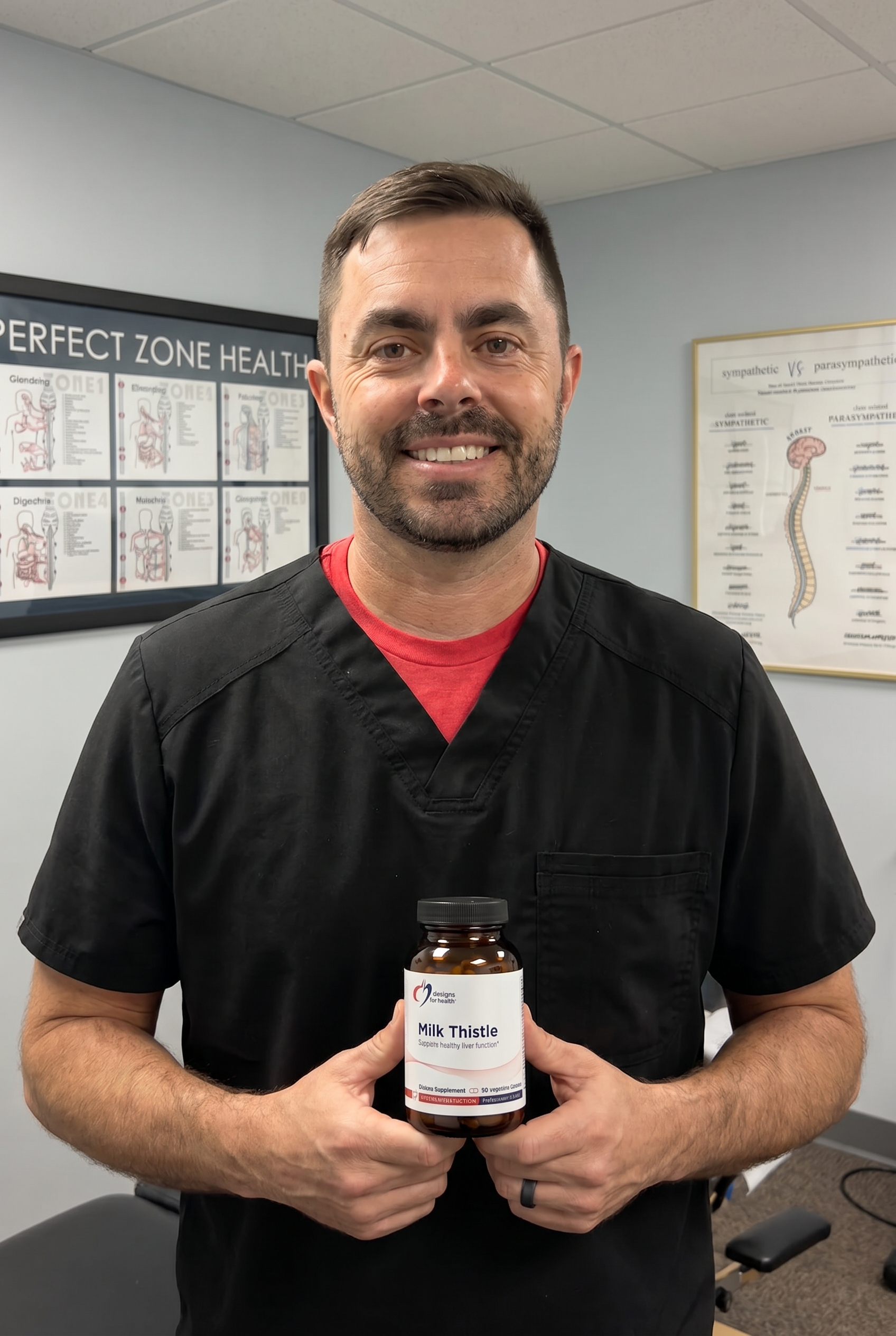
Milk Thistle Review by Designs for Health - Dr. Bell
Designs for Health Milk Thistle review by Dr. Bell. Standardized silymarin 80% extract for liver support, fatty liver, alcohol or medication recovery, and detoxification. Dosing, who benefits, side effects.

A 51-year-old executive came in with a liver panel that had been creeping up for three years. His ALT and AST were both about 1.5 times the upper limit of normal, his hepatologist had ruled out viral hepatitis and autoimmune causes, and his ultrasound showed mild fatty liver. He drank socially (not heavily, in his estimation), traveled for work, and ate well only some of the time. His gastroenterologist had told him to lose weight and cut back on alcohol. He had done both, but the numbers were still off.
I started him on Milk Thistle, two capsules twice a day with meals, alongside the lifestyle changes he was already making. Three months later his ALT and AST were back in the normal range for the first time in years, and his fatty liver showed clear improvement on follow-up imaging.
Milk thistle has been used for liver problems for two thousand years, and the science behind silymarin (its active compound) is some of the most studied phytomedicine in the world. For patients with fatty liver, mild liver enzyme elevation, recovery from medication or alcohol stress, or general liver support, this is the herb that earns its reputation.
Quick verdict: Milk Thistle is the liver herb I reach for when patients have non-alcoholic fatty liver, mildly elevated liver enzymes, medication or alcohol recovery, or general liver support needs in middle age and beyond.
Order Milk Thistle →What this product is actually doing
Silymarin is the family of bioactive compounds in milk thistle seed. It is not one molecule but a group of related flavonolignans, with silibinin being the most studied. Silymarin does several things in the liver, all of them aimed at protecting and repairing hepatocytes (liver cells).
It acts as an antioxidant, soaking up free radicals that damage liver cells. The liver is constantly exposed to chemicals (food, medications, alcohol, environmental toxins) and the metabolic processing of all of that creates oxidative stress as a byproduct. Silymarin helps the liver tolerate that stress without accumulating damage.
It stabilizes the liver cell membrane. Some toxins (the most famous being the death cap mushroom toxin, alpha-amanitin) get into liver cells and destroy them from the inside. Silymarin physically blocks some of these toxins at the cell membrane and prevents them from entering. This is why silymarin is used in emergency rooms (as IV silibinin) for mushroom poisoning.
It supports liver regeneration. The liver is the most regenerative organ in the body, but it needs the right inputs. Silymarin stimulates the synthesis of new ribosomes inside liver cells, which is the first step toward new protein production and new cell growth.
It supports phase II detoxification by raising glutathione levels in the liver, which is the master antioxidant the liver uses to process and clear chemicals.
DFH's Milk Thistle is standardized to 80% silymarin content. That standardization is the entire point. Random milk thistle products on the shelf can range from 30% to 80% silymarin content. The 80% standardization is what the research literature is based on, and it is the difference between a working dose and a token gesture.
What is in Milk Thistle
Each capsule contains:
- Milk Thistle seed extract (Silybum marianum), 200 mg, standardized to 80% silymarin
That works out to about 160 mg of silymarin per capsule. The standard clinical dose range for liver protection is 200 to 400 mg of silymarin per day, which means 2 to 3 capsules a day depending on how aggressive you need to be.
The seed extract is the right plant part. The leaves and flowers do not have meaningful silymarin content. Only the seeds carry the active compounds, and only at meaningful concentrations after extraction.
The 80% standardization is well above the 30 to 50% range you see in cheaper products, and it is the concentration used in the published clinical trials.
Who tends to do well on Milk Thistle
The pattern that responds best:
- Non-alcoholic fatty liver disease (NAFLD) with mild to moderate ALT or AST elevation
- Mild alcohol-related liver stress (recovery, occasional heavy weekends)
- Medication-induced liver enzyme elevation (acetaminophen recovery, isotretinoin users, methotrexate patients, certain antibiotics)
- Post-cleanse, post-chemotherapy, or post-illness liver support
- Patients with chronic medication burden where the liver is doing more work than usual
- People exposed to environmental toxins (firefighters, certain industrial workers, pesticide exposure)
- Type 2 diabetes (mild blood sugar lowering effect and fatty liver overlap)
- Mild gallbladder support (silymarin has a mild choleretic effect)
- Hangover recovery (modest evidence)
- Adjunct to weight loss programs (NAFLD overlap)
- Older adults with general aging-related liver function decline
Who should skip it
- Active hepatitis C on direct-acting antiviral medications (silymarin may interfere with drug levels in some cases; talk to your hepatologist)
- Severe cirrhosis or end-stage liver disease without specialist supervision
- Patients on cyclosporine or tacrolimus (transplant patients; silymarin can affect drug levels)
- Anyone with severe ragweed, daisy, or marigold allergy (cross-reactivity with milk thistle, a member of the same plant family)
- Pregnant or nursing women without their prescriber's input
- Patients on certain HIV medications (drug interaction potential)
- Hormone-sensitive cancer patients should check with oncology (silymarin has weak estrogenic activity in some test systems, though clinical relevance is unclear)
I Trust DFH for My Own Patients
I send my own patients to Designs for Health for Milk Thistle because I trust their formulations, sourcing, and quality control. When you order through my DFH store, you get the same direct-from-manufacturer authenticity I get for my own family, with practitioner pricing applied automatically.
Order Milk Thistle →How to take it
For active liver issues (elevated enzymes, fatty liver, alcohol or medication recovery): two capsules twice a day with meals, for 12 to 16 weeks. Recheck liver enzymes and imaging at that point.
For general liver support and prevention (older adults, mild medication burden, chronic low-level alcohol exposure): one to two capsules a day with meals, ongoing or in 8 to 12 week cycles a few times a year.
For occasional liver stress (after a heavy weekend, a course of acetaminophen, or a stretch of restaurant eating): two capsules twice a day for 2 to 4 weeks.
Always take with food. Silymarin is fat-soluble and absorbs much better with a meal that contains some fat (10 grams or more). Without food, absorption is very low and the product underperforms.
Timing: morning and evening with breakfast and dinner is the simplest pattern.
What to expect
- Weeks 1 to 2: most patients do not feel a dramatic change yet. Liver work is quiet.
- Weeks 4 to 6: subjective improvements often start. Energy can come up, food tolerance gets better, alcohol hits less hard than it used to.
- Weeks 8 to 12: liver enzymes (ALT and AST) often drop meaningfully on follow-up labs. A 30 to 50% reduction in elevation is realistic for many patients with fatty liver.
- 3 to 6 months: imaging studies often show real improvement in fatty liver. Liver elasticity (a FibroScan measurement) can improve.
- If you stop: the protective effect fades as silymarin clears the body within a few days. For chronic liver stress, ongoing or cyclical use is the pattern that holds the gain.
Side effects
- Very well tolerated. Milk thistle has one of the cleanest safety records in herbal medicine.
- Mild laxative effect or loose stool in some patients (the choleretic effect on bile flow can do this)
- Mild gas or bloating, occasionally
- Headache, rare
- Allergic reaction in people with severe daisy/ragweed allergies
- Drug interactions: cyclosporine, tacrolimus, certain HIV protease inhibitors, and possibly some cancer medications. The literature is mixed but cautious coordination with the prescriber is reasonable.
- Mild blood-sugar-lowering effect; diabetics on insulin or oral hypoglycemics should monitor glucose
What I do not love about it
Silymarin absorption is genuinely not great. Even with food, only a small fraction of the dose actually reaches the liver. This is why the doses look high (300 to 400 mg/day of silymarin) compared to other supplements. Newer formulations (silybin-phosphatidylcholine complex, also called siliphos) absorb much better and need lower doses to do the same work. DFH's Milk Thistle is the standardized whole extract, which has the longest research history and is what I default to, but for severe liver issues some hepatologists prefer the higher-bioavailability complex.
Milk thistle is not a substitute for the lifestyle changes that drive the most improvement in NAFLD: weight loss, reduced refined carbohydrates, less alcohol, more exercise. Patients who take the capsules and skip the lifestyle work see modest gains. Patients who do both see real improvement.
And one practical note: the capsule has a slight herbal odor that some patients find off-putting. It is harmless and a sign of the actual plant material in the capsule, but worth knowing.
For background, the NIH National Center for Complementary and Integrative Health summary on milk thistle covers the major clinical evidence, and the PMC review on silymarin and liver disease goes into mechanism and trial data.
Bottom line
Milk Thistle is the liver herb I reach for when patients have non-alcoholic fatty liver, mildly elevated liver enzymes, medication or alcohol recovery, or general liver support needs in middle age and beyond. The 80% silymarin standardization is what the research literature uses, and DFH's product matches that benchmark. Two capsules twice a day with meals for active issues, one to two a day for maintenance, always with food. Allow 12 weeks to see meaningful change on labs.
Always check with a healthcare provider before starting any new supplement, especially if you take prescription medication or have an active liver condition.
← See all healthy aging reviews by Dr. Bell
Ready to try Milk Thistle?
It is one I trust enough to use with my own patients and order for my family. Through my DFH store you get the authentic, direct-from-manufacturer product with practitioner pricing applied automatically at checkout.
Order Milk Thistle →Authentic, direct from Designs for Health · practitioner pricing · no third-party counterfeits
About the Author: Dr. Bell
Dr. Bell is a chiropractor and holistic wellness practitioner at Dr. Bell Health. He writes plain-language reviews of Designs for Health supplements based on years of clinical experience. Read more about Dr. Bell.