Monolaurin-Avail Review by Designs for Health - Dr. Bell
Designs for Health Monolaurin-Avail review by Dr. Bell. Monolaurin (glycerol monolaurate) from the same fat in coconut, with vitamin C and sunflower lecithin for absorption, used for immune and microbial-balance support. Dosing, who benefits, side effects, and honest expectations.

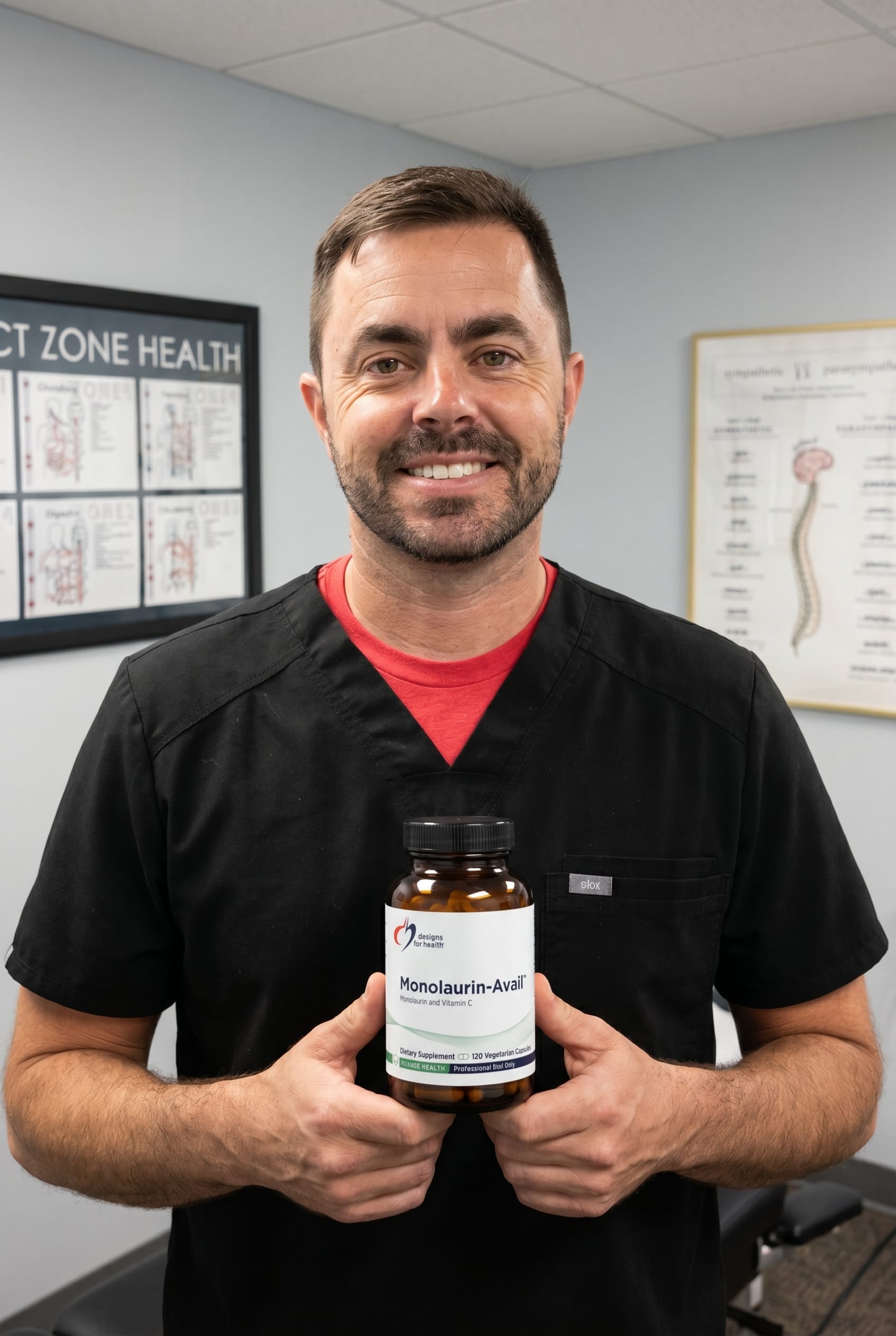
A 44-year-old man came to me in the thick of a rough winter. He felt like he was catching every bug that went around his office and his kids' school, and he was tired of feeling run-down. He had read online about monolaurin, a compound derived from coconut fat, and the claims he had seen ranged from reasonable to frankly wild. He wanted a straight answer: is this a real immune-support ingredient worth taking, or just another internet supplement with a lot of hype and not much behind it?
I appreciated the skepticism, because monolaurin is genuinely interesting and also genuinely over-hyped, and the two get tangled together online. Monolaurin is a compound your body makes from lauric acid, the same medium-chain fat that is abundant in coconut and in breast milk. In the lab, it has shown the ability to disrupt the protective outer coat of certain microbes that have a fatty membrane. That is a real and interesting property, and it is the basis for using it as immune and microbial-balance support. It is also where the hype outruns the evidence, which I will be honest about. I talked him through it and started him on Monolaurin-Avail.
What makes Monolaurin-Avail distinct is that it delivers a solid dose of monolaurin alongside vitamin C and sunflower lecithin to help with absorption, and I will explain that below. Used as part of a sensible seasonal-wellness routine, alongside the basics that actually matter most, he felt it was a reasonable addition to his winter toolkit. A monolaurin supplement is not an antibiotic or an antiviral drug and it does not treat infection, but as general immune and microbial-balance support it is a reasonable option. Monolaurin-Avail is the monolaurin formula I reach for.
Quick verdict: Monolaurin-Avail is the monolaurin formula I reach for when someone wants to add this coconut-derived compound to an immune-support routine.
Order Monolaurin-Avail →What this product is actually doing
Monolaurin is a monoglyceride, a compound made by attaching lauric acid to a molecule of glycerol. Lauric acid is a medium-chain fatty acid found in high amounts in coconut oil and in human breast milk, and monolaurin is one of the forms the body can make from it. The reason it draws so much interest is a specific lab observation: monolaurin can disrupt the fatty outer envelope that surrounds certain microbes, the lipid coat that some bacteria and lipid-enveloped viruses depend on.
That property is why monolaurin gets used as general immune and microbial-balance support. The idea is to provide a compound that, at least in laboratory settings, can interfere with organisms that have that fatty membrane, as a way to support the body's own defenses and a healthy microbial environment. It is important to be precise here: most of the strongest evidence is from test-tube and lab studies, and the picture in living humans is far less settled. So I frame monolaurin as supportive nutrition, not as a proven antimicrobial treatment.
Monolaurin-Avail is built to deliver a meaningful dose of monolaurin in a usable form. It pairs the monolaurin with vitamin C, a long-standing immune-support nutrient, and with sunflower lecithin, which is included to help the body absorb the monolaurin, since on its own it is a waxy, fat-like substance that does not dissolve easily. For someone who wants to take monolaurin specifically as part of an immune-support routine, this is a clean, sensibly formulated way to do it.
What is in Monolaurin-Avail
The formula is focused, with an absorption helper built in:
- Monolaurin (as glycerol monolaurate), 1 gram per serving (the medium-chain monoglyceride derived from lauric acid; the main active)
- Vitamin C (as ascorbic acid), 170 mg per serving (a classic immune-support nutrient that complements the monolaurin)
- Sunflower lecithin (included to help the body absorb the otherwise waxy, hard-to-dissolve monolaurin)
- Two capsules per serving (the standard daily dose, taken with a meal)
The thoughtful detail here is the sunflower lecithin. Monolaurin on its own is a waxy substance that the gut does not absorb readily, so pairing it with lecithin, an emulsifier, is a sensible move to improve uptake. Adding vitamin C gives a second, well-established immune-support angle. The result is a focused immune-and-microbial-balance product rather than a kitchen-sink blend, which is how I prefer to use monolaurin: as one clear ingredient at a real dose.
Who tends to do well on Monolaurin-Avail
The pattern that fits best:
- Adults who want to add a monolaurin-based support to a seasonal immune routine
- People interested in supporting a healthy microbial balance as part of a broader wellness plan
- Those who have read about monolaurin and want a sensibly formulated, well-absorbed version
- People who prefer a single, focused active over a complex immune blend
- Those already doing the foundational immune basics and wanting an additional nutritional layer
- Adults working with a provider on a microbial-balance or immune-support approach
Who should skip it
- Anyone who is acutely sick with a significant infection and needs real medical care, not a supplement
- People expecting it to function like an antibiotic or antiviral drug; it is not one
- Those with a known coconut or sunflower-lecithin sensitivity
- People on multiple medications who have not checked for interactions with their pharmacist or provider
- Pregnant or breastfeeding women, without provider guidance
Buy Monolaurin-Avail Direct from DFH
Practitioner pricing is applied automatically at checkout. Every bottle ships direct from the Designs for Health warehouse with full quality control. The same product DFH stocks on its own shelves, at the practitioner price tier.
Shop Monolaurin-Avail →How to take it
Take it consistently and with food.
- Take the label dose, typically two capsules per day, with a meal; the food and the lecithin both help absorption.
- Some people use it daily through a high-exposure season; others use it more intermittently. Either fits as general support.
- Pair it with the basics that genuinely move the needle on immunity: sleep, real food, movement, stress management, and staying current on appropriate vaccinations.
- Keep it as a support, not a substitute. If you get truly sick, that is a time for medical evaluation, not for relying on a supplement.
- Check with your pharmacist or provider if you take other medications.
What to expect
- This is general, supportive nutrition; do not expect a dramatic, drug-like effect
- Any benefit is best thought of as part of a broader immune-support routine, not a standalone fix
- It does not treat or cure infections, and the human evidence is limited, so keep expectations grounded
- The vitamin C and the overall routine matter as much as the monolaurin itself
Side effects
- Generally well tolerated
- Mild digestive upset, such as nausea or loose stools, in some people, especially without food
- Some people report a temporary feeling of being more run-down when starting; if that happens, lowering the dose is reasonable
- Rare allergic reaction in anyone sensitive to coconut-derived ingredients or sunflower lecithin
What I do not love about it
My biggest issue is not with the product but with the hype around the ingredient. Online, monolaurin is sometimes described as a natural antibiotic or antiviral that can knock out serious infections. That is not a claim I will make. The most striking effects on microbes come from lab and test-tube studies, and the evidence that taking monolaurin by mouth produces those same effects inside the human body is limited and far from settled. I present it honestly as supportive nutrition, not as a treatment, and I think anyone selling it as more than that is getting ahead of the science.
That honesty cuts to a real safety point: if someone is genuinely sick, with a significant or worsening infection, a fever that will not break, or symptoms that are getting worse, that is a moment for medical care, not for leaning on a supplement and hoping. I never want monolaurin, or any immune-support product, to become a reason someone delays getting properly evaluated and treated. Used as a complement to good medical care and the real immune basics, it is reasonable; used as a replacement for them, it is a problem.
And I always come back to the foundations. The things that most reliably support immune function are not exotic: consistent sleep, a nutrient-dense diet, regular movement, managing chronic stress, not smoking, and appropriate vaccination. Monolaurin is an interesting nutritional layer on top of that foundation; it is not the foundation, and no capsule is. For the person who has those basics in place and wants to add a sensibly dosed, well-absorbed monolaurin as part of a seasonal routine, Monolaurin-Avail is a clean way to do exactly that, with realistic expectations.
For background, see the PMC review on lauric acid and monolaurin antimicrobial activity, the NIH Office of Dietary Supplements fact sheet on vitamin C, and the NIH NCCIH overview of supplements and immune support.
Bottom line
Monolaurin-Avail is the monolaurin formula I reach for when someone wants to add this coconut-derived compound to an immune-support routine. It delivers a full gram of monolaurin per serving alongside vitamin C and sunflower lecithin to aid absorption. Take it with food, keep expectations realistic, since the human evidence is limited, and build it on the immune basics that do the real work: sleep, nutrition, movement, and stress management.
Always check with a healthcare provider before starting any new supplement, especially if you are acutely ill, take other medications, or are pregnant or breastfeeding. This product is not intended to diagnose, treat, cure, or prevent any disease.
← See all immune health reviews by Dr. Bell
Ready to try Monolaurin-Avail?
It is one I trust enough to use with my own patients and order for my family. Through my DFH store you get the authentic, direct-from-manufacturer product with practitioner pricing applied automatically at checkout.
Order Monolaurin-Avail →Authentic, direct from Designs for Health · practitioner pricing · no third-party counterfeits
About the Author: Dr. Bell
Dr. Bell is a chiropractor and holistic wellness practitioner at Dr. Bell Health. He writes plain-language reviews of Designs for Health supplements based on years of clinical experience. Read more about Dr. Bell.