Mood-Stasis Review by Designs for Health - Dr. Bell
Designs for Health Mood-Stasis review by Dr. Bell. A fast-acting mood and stress formula with standardized saffron (Safr'Inside), Zembrin sceletium, and methylated folate and B12. Dosing, who benefits, side effects, and the important antidepressant-interaction caution.

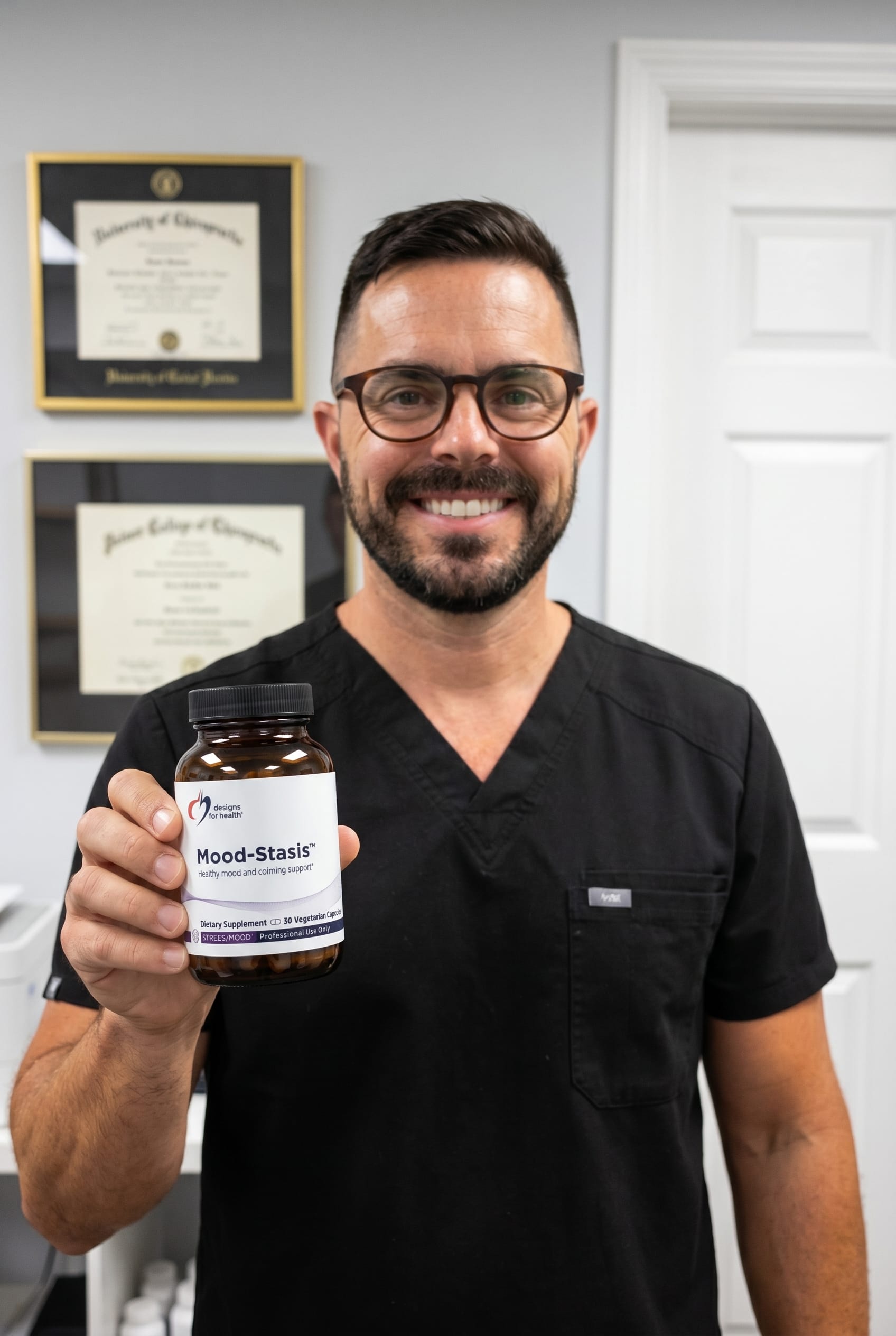
A 35-year-old woman came to me describing a low-grade gray cloud that had settled over the past several stressful months. She was not in crisis, and she did not feel she needed a prescription, but she felt flat, easily worn down, and not quite herself. She had been reading about saffron for mood and asked whether it was real or just another wellness fad, and whether there was a thoughtful, natural option she could try while she worked on the bigger picture of stress, sleep, and getting support.
This is a conversation I have carefully, because mood is exactly the area where I want to be both helpful and responsible. The encouraging news is that a couple of botanicals have surprisingly solid research for supporting a calmer, more positive mood, saffron is the standout, and a South African plant called sceletium (sold as the standardized extract Zembrin) is another. Pairing those with the B vitamins the brain uses to make and balance its mood chemicals is a sensible, evidence-aware approach to gentle mood support. That is exactly how this product is designed. I talked her through it, and the cautions, and started her on Mood-Stasis.
What makes Mood-Stasis distinct is that it uses the specific, standardized forms of saffron and sceletium that were actually studied, plus methylated B12 and folate, and I will explain that below. Used alongside the real work of managing stress, protecting sleep, moving her body, and leaning on her support system, she felt it took some of the edge off the gray cloud. A mood-support supplement is not an antidepressant and it does not replace mental health care, but as gentle, targeted mood-and-stress support it is a reasonable tool for the right person. Mood-Stasis is the mood formula I reach for.
Quick verdict: Mood-Stasis is the gentle mood-support formula I reach for when someone has everyday low mood or stress, is not in crisis, and is not taking a serotonergic medication.
Order Mood-Stasis →What this product is actually doing
Your mood is shaped, in part, by brain chemicals like serotonin and dopamine, and by how well your body manages stress signaling. Several natural compounds have been studied for gently supporting that system. Saffron, the spice from the crocus flower, has a genuinely interesting body of research suggesting it can support a more positive mood, and standardized saffron extracts have shown effects that some studies note within a relatively short window. Sceletium, used traditionally in South Africa and standardized as Zembrin, has research for supporting a calmer, more balanced mood and stress response.
Mood-Stasis combines those two botanicals with the B vitamins folate and B12, which the body uses in the methylation pathways that help make and regulate neurotransmitters. Importantly, it uses the already-active, methylated forms of those vitamins (methylfolate and methylcobalamin), which is helpful because a meaningful number of people have genetic variations that make it harder to activate the standard forms. So the design idea is two well-studied mood botanicals plus the B-vitamin cofactors that support the brain's own mood chemistry.
Just as important is what the standardized forms mean. The saffron here is a patented, standardized extract (Safr'Inside), and the sceletium is Zembrin, the specific extract used in the research, at the amounts that were studied. That matters because with botanicals, the studied, standardized extract at the studied dose is what gives you a reasonable expectation of an effect, rather than a generic, unstandardized herb of unknown strength. For someone wanting gentle, evidence-aware mood support, that attention to the actual studied ingredients is the point.
What is in Mood-Stasis
The formula is focused on the studied actives:
- Saffron extract (Safr'Inside, Crocus sativus), 30 mg standardized to its active crocins (the well-studied mood botanical, in a patented, fast-acting extract)
- Sceletium extract (Zembrin, Sceletium tortuosum), 25 mg standardized to its alkaloids (a traditional botanical for calm, balanced mood)
- Folate (as Quatrefolic methylfolate), 1,360 mcg DFE (the already-active form of folate for neurotransmitter and methylation support)
- Vitamin B12 (as methylcobalamin), 2,000 mcg (the active form of B12, a cofactor in mood chemistry)
- One capsule per day (a simple, once-daily dose)
The defining feature is that these are the named, standardized extracts used in research, Safr'Inside saffron and Zembrin sceletium, at studied amounts, rather than generic herbs. Backing them with methylated folate and B12 supports the body's own neurotransmitter production. The result is a clean, once-daily mood-support formula. It is worth knowing that sceletium and saffron both have mild activity on serotonin pathways, which is precisely why the interaction caution below matters so much.
Who tends to do well on Mood-Stasis
The pattern that fits best:
- Adults with everyday low mood or stress who are not in crisis and want gentle, natural support
- People going through a stretch of high stress who want help taking the edge off
- Those drawn to the saffron and sceletium research who want the actual studied, standardized extracts
- People who want a simple, once-daily option with the active forms of folate and B12
- Those using it as one piece alongside the real work of stress management, sleep, movement, and support
- Adults who are not taking an antidepressant or other serotonergic medication (see the caution below)
Who should skip it
- Anyone taking an antidepressant or other serotonergic medication (SSRIs, SNRIs, MAOIs, and similar), unless their prescriber specifically approves it, because combining serotonergic agents can be dangerous
- People in genuine crisis, or with significant or worsening depression, who need real mental health care, not a supplement
- Pregnant or breastfeeding women, since saffron in particular is not recommended without provider guidance
- People with bipolar disorder or other serious psychiatric conditions, without provider oversight
- Anyone with a known sensitivity to saffron or sceletium
Mood-Stasis Direct from the Manufacturer
Most supplements are heat- and humidity-sensitive, and potency drops fast in a third-party warehouse. Buying through my DFH store means your bottle goes from their climate-controlled facility straight to your door, at practitioner pricing.
Order Mood-Stasis →How to take it
Keep it simple, and keep your prescriber in the loop.
- Take one capsule per day, with or without food, at a consistent time.
- Before starting, confirm you are not on any antidepressant or serotonergic medication, or that your prescriber has specifically cleared the combination. This is the single most important step.
- Give it a few weeks of consistent use to judge it, while you also do the foundational work.
- Treat it as one piece of a bigger plan: protecting sleep, moving your body, managing stress, limiting alcohol, and leaning on your support network or a therapist.
- If your mood is worsening or you ever have thoughts of harming yourself, stop relying on a supplement and reach out for real support right away.
What to expect
- Some people notice a gentle lift or a calmer baseline within a couple of weeks; saffron's studied extract has shown relatively early effects in research
- The effect is supportive and subtle, not the strength of a prescription medication
- It works best as one part of a broader plan, not as a standalone fix
- Individual responses vary; it is reasonable to reassess after a few weeks with your provider
Side effects
- Generally well tolerated at the label dose
- Mild digestive upset, headache, or drowsiness in some people
- The serious concern is combining it with antidepressants or other serotonergic agents, which can raise the risk of too much serotonin activity
- Rare allergic reaction in anyone sensitive to saffron or sceletium
What I do not love about it
The caution I lead with, every single time, is the interaction with antidepressants and other serotonergic medications. Both saffron and sceletium have mild activity on serotonin pathways, and stacking that on top of an SSRI, SNRI, MAOI, or similar medication can, in principle, contribute to serotonin excess, which is a genuinely dangerous state. This is not a theoretical nicety. If you are on any medication for mood, you do not start this without your prescriber's explicit sign-off. I would rather repeat that warning three times than have someone combine the two without thinking.
My second concern is making sure a supplement never becomes a substitute for real care. Mood-Stasis is for the everyday, not-in-crisis, gray-cloud kind of low mood and stress. It is not for significant depression, and it is absolutely not for anyone in crisis. Depression that is moderate, severe, worsening, or accompanied by any thoughts of self-harm needs real mental health support, not a capsule. I am always clear that gentle mood support and actual treatment are different things, and I never want the existence of a nice supplement to delay someone getting the help they deserve.
And as with every mood and stress tool, the foundation matters most. Sleep, movement, sunlight, connection, limiting alcohol, and managing the actual stressors in your life do more for mood than any supplement, and a capsule cannot paper over a life that is chronically short on those things. Mood-Stasis, with its genuinely well-chosen, standardized saffron and sceletium and active B vitamins, is a thoughtful, gentle support for the right person who is also doing that real work, and who has confirmed it is safe alongside any medications they take. Used that way, it is a reasonable and well-designed option.
Mental health is a sensitive topic. If you are struggling with your mood, please consider reaching out to a healthcare professional or someone you trust; if you are ever in crisis or having thoughts of harming yourself, contact your local emergency services or a crisis line right away. For background, see the PMC review on saffron for depressive symptoms, the NIH NCCIH overview of saffron, and the NIH National Institute of Mental Health resource on depression.
Bottom line
Mood-Stasis is the gentle mood-support formula I reach for when someone has everyday low mood or stress, is not in crisis, and is not taking a serotonergic medication. It pairs the actual studied, standardized extracts of saffron (Safr'Inside) and sceletium (Zembrin) with the active forms of folate and B12. Take one capsule daily, give it a few weeks, and use it as one piece alongside the sleep, movement, stress management, and support that do the real work.
The most important step is to confirm with your prescriber that it is safe if you take any antidepressant or other mood medication. Always check with a healthcare provider before starting any new supplement, especially if you are pregnant or breastfeeding or have a diagnosed psychiatric condition. This is a sensitive area, and real mental health support should never be replaced by a supplement.
← See all stress, mood and sleep reviews by Dr. Bell
Ready to try Mood-Stasis?
It is one I trust enough to use with my own patients and order for my family. Through my DFH store you get the authentic, direct-from-manufacturer product with practitioner pricing applied automatically at checkout.
Order Mood-Stasis →Authentic, direct from Designs for Health · practitioner pricing · no third-party counterfeits
About the Author: Dr. Bell
Dr. Bell is a chiropractor and holistic wellness practitioner at Dr. Bell Health. He writes plain-language reviews of Designs for Health supplements based on years of clinical experience. Read more about Dr. Bell.