NeuroCalm Review by Designs for Health - Dr. Bell
Designs for Health NeuroCalm review by Dr. Bell. A focused calming formula using GABA, L-theanine, and supporting B vitamins to ease anxious thinking and tension without sedation. Dosing, who benefits, side effects, and how it compares to other calming options.

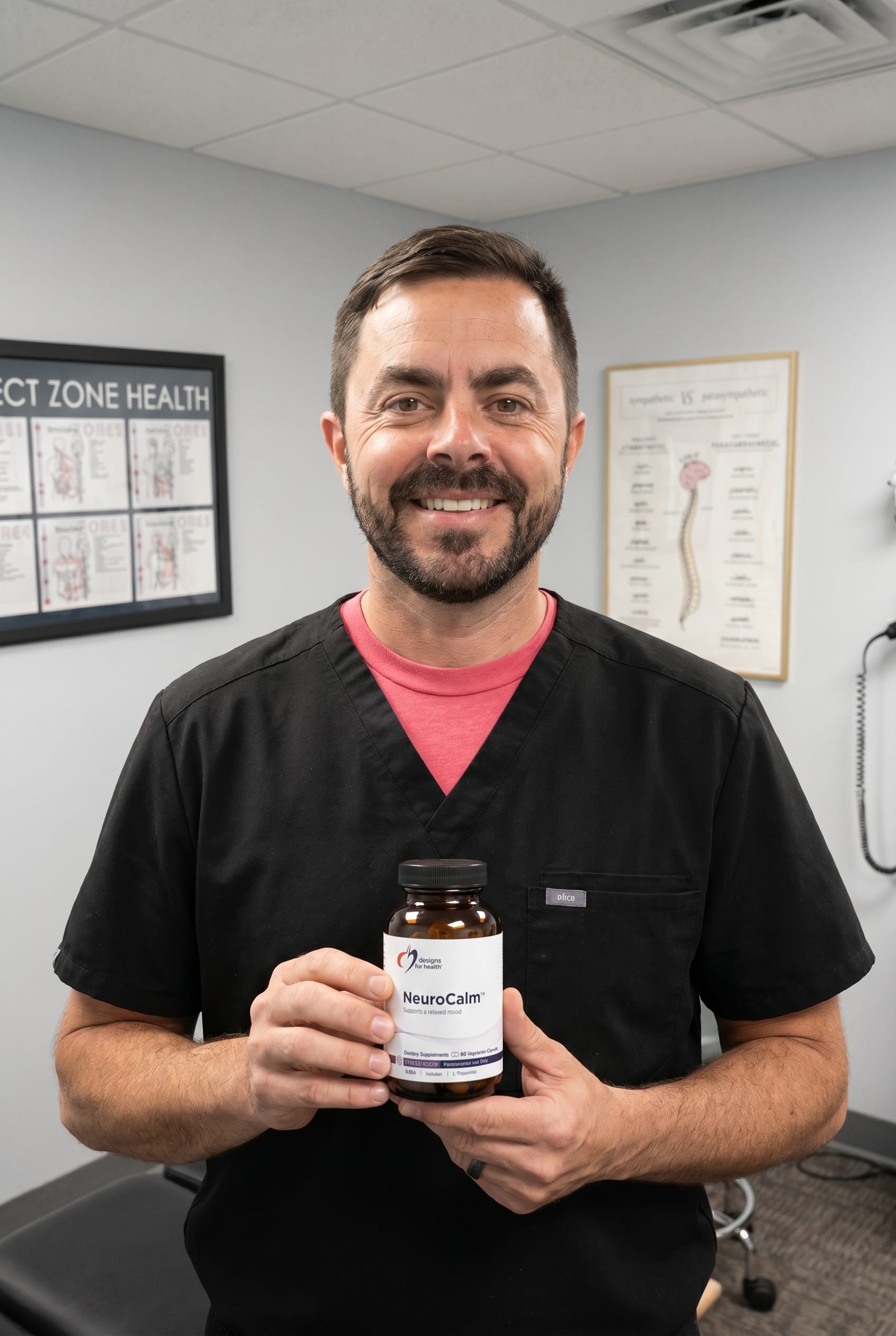
A 36-year-old man came to me with a familiar pattern: a busy job, a busy head, and a constant background of anxious thinking that he could not seem to switch off. He was not having panic attacks and his doctor had not put him on medication; he was just tired of feeling keyed up, of mentally rehearsing tomorrow at midnight, and of how rough it made him feel by Friday. He wanted to take the edge off the mental noise without feeling sedated and without committing to a prescription, and he asked what made sense.
This is right in the wheelhouse of a well-built calming amino-acid formula. The body has its own braking system for the nervous system, anchored by a chemical messenger called GABA, which quiets the constant chatter of the brain when it gets too loud. Modern life keeps the foot on the gas pedal, so the brakes can feel overwhelmed. The idea behind a product like this is not to sedate you, but to gently support the brain's own calming pathways so the volume of the anxious chatter comes down a notch. I started him on NeuroCalm.
The strength of NeuroCalm is its combination of two well-known calming ingredients with the right cofactors to make them work, and I will explain that below. Over a couple of weeks of consistent use, he felt his head was quieter, his evenings were calmer, and he could think through stressful afternoons without spiraling. A calming supplement is not therapy and it is not a treatment for diagnosed anxiety, but as gentle, non-sedating daily support it is one of my favorite tools. NeuroCalm is the focused calming formula I reach for.
Quick verdict: NeuroCalm is the focused calming formula I reach for when someone wants daytime calm with mental clarity, and they want to support the brain's own calming pathways rather than take a sedative.
Order NeuroCalm →What this product is actually doing
Your brain has both "go" signals and "stop" signals. The main calming signal in the brain is a messenger called GABA, which quiets overactive nerve chatter and is the reason you can settle and think clearly. When stress and stimulation stay high for a long time, the GABA signal can feel outmatched, which is part of what produces the racing-thought, can't-switch-off feeling many people describe.
NeuroCalm is built to support that calming side of the brain, rather than to sedate or knock you out. The aim is daytime calm with mental clarity: enough quiet to take the edge off the noise, but not so much that you cannot function. It does this by combining ingredients that support GABA's calming effect with one of the few well-studied calming compounds (L-theanine) that produces a unique "relaxed but alert" mental state, which is a much better fit for daytime life than a sedating herb.
It does this with a focused, non-sedating blend rather than a kitchen-sink mix. GABA is included directly, L-theanine (the calming compound from green tea, famous for the calm-but-clear feeling) is paired with it, and the formula includes the B vitamins and cofactors the brain needs to build its own calming neurotransmitters. The result is a calming formula designed for clarity, not for sleep.
What is in NeuroCalm
The formula is a focused, clarity-friendly calming blend:
- GABA (the brain's main calming neurotransmitter, included directly to support a sense of relaxation)
- L-theanine (the calming compound from green tea, well-known for producing a "relaxed but alert" mental state)
- Vitamin B6 (as pyridoxal-5-phosphate) (the active form of B6, a key cofactor for building calming neurotransmitters)
- Supporting B vitamins and cofactors (to back the calming amino acids with the building blocks they need to work)
The signature of this formula is the GABA-plus-theanine pairing. GABA targets the brain's main calming signal directly, and L-theanine is one of the most well-studied calming compounds with a unique reputation for not making people drowsy. Adding the active form of B6 (the spark plug the brain uses to build calming neurotransmitters from amino acids) means the formula is not just dropping in calming chemicals, but also supporting the brain's own production of them. It is a small, sensible blend.
Who tends to do well on NeuroCalm
The pattern that responds best:
- People with everyday stress and a constant background of anxious thinking
- Those who feel mentally keyed up or "wired" and want to take the edge off without sedation
- People who want daytime calm with mental clarity, not drowsiness
- Those whose stress shows up as racing thoughts more than as physical tension
- People who want a non-habit-forming option to keep on hand for stressful stretches
- Anyone wanting gentle support for the brain's own calming system while they also do the real work
Who should skip it
- Anyone taking sedatives, anti-anxiety medication, or antidepressants, without provider input (calming effects can stack)
- People with diagnosed anxiety, panic disorder, or another mental health condition who need proper treatment, not a supplement alone
- Those who feel unusually drowsy on calming products and need to drive or operate machinery
- Pregnant or breastfeeding women, without provider guidance
- Anyone whose "anxiety" is actually pointing at a situation that genuinely needs to change
Get NeuroCalm at Practitioner Pricing
Direct from Designs for Health, below standard retail. Practitioner pricing is applied automatically at checkout. Every bottle is authentic, properly stored, and ships fast from the DFH warehouse.
Order NeuroCalm →How to take it
Use it during the day, as needed, for calm with clarity.
- Take the label dose when you feel anxious thinking building, or proactively before a known stressful stretch.
- It is designed for daytime use; the L-theanine in it is specifically known for not causing drowsiness, so a workday is fine.
- It can be taken with or without food; with a little food is fine if it sits better.
- Start with a single serving to see how you respond before taking more.
- It works well as an as-needed tool rather than something you necessarily take every day forever.
What to expect
- Often fairly quickly: a gentler, quieter head and a settled feeling within an hour or so
- The L-theanine "relaxed but alert" effect is the headline; many people describe being calm without being foggy
- Effects are gentle support; this is not the heavy hand of a sedative
- Best paired with the basics: sleep, movement, and dealing with the real sources of stress
Side effects
- Generally very well tolerated
- Mild drowsiness in some people at higher doses
- Occasional mild digestive upset or headache
- Possible additive effect with sedatives, anti-anxiety medication, or alcohol
What I do not love about it
The honest framing I lead with is that a calming supplement treats the feeling of anxious thinking, not the cause. NeuroCalm can absolutely take the edge off, but if the underlying picture is a schedule that is too packed, a relationship that is bleeding the person dry, a job that is not sustainable, or genuine anxiety that needs real treatment, no capsule fixes that. I am careful to use it as gentle support while we look at what is actually fueling the noise, because relying on a calming supplement to paper over a situation that should change is a trap.
There is also fair scientific debate about how well GABA taken by mouth crosses into the brain, since the brain has a protective barrier that GABA does not pass easily. Many people clearly feel calmer on GABA-containing formulas, which may come through several routes including the gut-brain connection, but I do not oversell the mechanism. The L-theanine side of the formula has more direct support, with multiple studies on its "relaxed but alert" effect. I judge it by how people respond, and most do well; some feel a clear shift, others feel little.
And it is gentle by design, which is its strength and its limit. For everyday anxious thinking it is a useful tool; for genuine generalized anxiety disorder, panic disorder, or a mood disorder it is not enough, and those deserve real evaluation and proper treatment, which may include therapy or medication. The medication interaction point matters too: if someone is on a sedative, anti-anxiety drug, or antidepressant, calming effects can add up, and I always have them check with their prescriber. Used sensibly, for the right person, it is a helpful nudge toward calm with clarity, not a cure.
For background, see the PMC review on GABA, stress, and relaxation, the PMC review on L-theanine, stress, and cognition, and the NIH NIMH overview of anxiety disorders.
Bottom line
NeuroCalm is the focused calming formula I reach for when someone wants daytime calm with mental clarity, and they want to support the brain's own calming pathways rather than take a sedative. It pairs GABA with L-theanine (the calm-but-alert compound from green tea) and the active form of B6, so the formula nudges the brain toward quiet without fog. Take it as needed when anxious thinking builds, and pair it with sleep, movement, and addressing the real sources of stress.
Always check with a healthcare provider before starting any new supplement, especially if you take sedatives, anti-anxiety medication, or antidepressants, have a diagnosed anxiety or mood disorder, or are pregnant or breastfeeding.
← See all stress, mood and sleep reviews by Dr. Bell
Ready to try NeuroCalm?
It is one I trust enough to use with my own patients and order for my family. Through my DFH store you get the authentic, direct-from-manufacturer product with practitioner pricing applied automatically at checkout.
Order NeuroCalm →Authentic, direct from Designs for Health · practitioner pricing · no third-party counterfeits
About the Author: Dr. Bell
Dr. Bell is a chiropractor and holistic wellness practitioner at Dr. Bell Health. He writes plain-language reviews of Designs for Health supplements based on years of clinical experience. Read more about Dr. Bell.