ProbioMed 100 Review by Designs for Health - Dr. Bell
Designs for Health ProbioMed 100 review by Dr. Bell. 100 billion CFU, eight researched strains, shelf-stable probiotic for antibiotic recovery, IBS, and gut barrier repair. Dosing, who benefits, side effects.

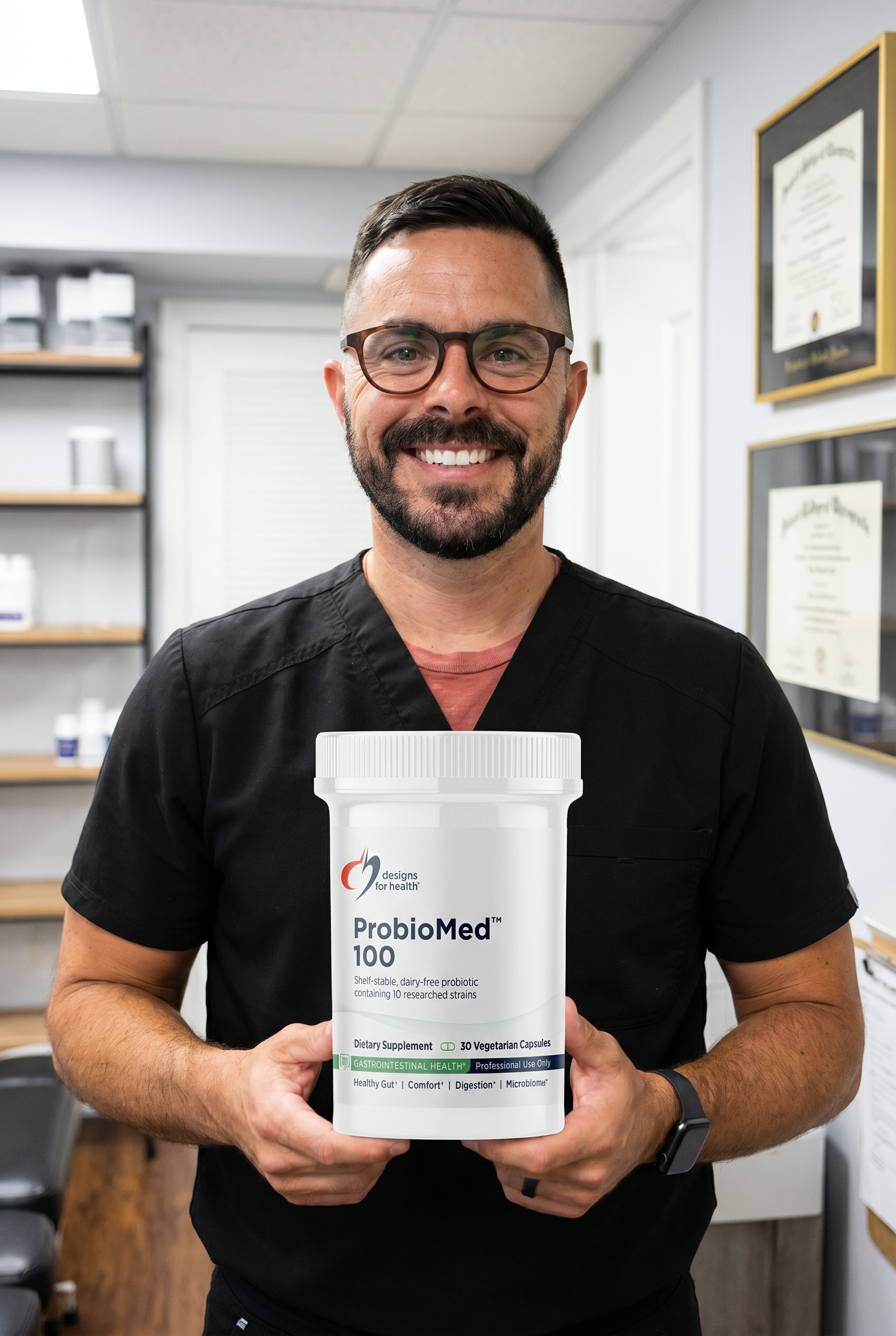
A 52-year-old patient came to me after a brutal round of antibiotics for a sinus infection that had spiraled into pneumonia. Two weeks of strong, broad-spectrum antibiotics had cleared the infection, but his digestion had not recovered. He had loose stool every morning, a bloated feeling after almost every meal, and a level of fatigue he could not shake. His primary care doctor told him to "give it time." That had been three months ago.
I started him on ProbioMed 100, one capsule a day at bedtime, on an empty stomach. Within two weeks his bowel movements were back to normal. Within six weeks the bloating was gone and he had his energy back. He kept taking it for another two months to make sure the gut lining had fully recovered, then dropped to a maintenance probiotic.
For serious gut situations, where the bacterial community needs real repair, a 100 billion CFU multi-strain probiotic is the right tool. Most over-the-counter probiotics are dosed too low to do much when you actually need them.
Quick verdict: ProbioMed 100 is the high-potency multi-strain probiotic I use for patients with active gut symptoms, recent antibiotic use, or significant digestive disruption.
Order ProbioMed 100 →What this product is actually doing
Your gut is home to roughly 100 trillion bacteria. They digest food, make vitamins (B12, K2), train your immune system, produce neurotransmitters that affect mood, and maintain the lining of the intestinal wall. When this community gets disrupted, almost everything downstream suffers.
Antibiotics are the most common cause of major disruption. So is food poisoning. So is a long stretch of poor sleep, chronic stress, or a heavy-handed acid blocker like a proton pump inhibitor. Once the community is off, it does not always recover on its own. Some patients limp along for years with low-grade bloating, fatigue, and irregular bowel habits without realizing their gut bacteria never came back.
ProbioMed 100 delivers 100 billion live colony-forming units across eight strains. The strains are chosen specifically because they have been studied in humans for things like IBS, antibiotic-associated diarrhea, leaky gut, and immune support. The bacteria reach the small intestine alive, take up temporary residence, and create the environment that lets the native bacterial community rebuild itself.
What is in ProbioMed 100
Each capsule contains 100 billion CFU across eight strains:
- Lactobacillus acidophilus (La-14)
- Lactobacillus paracasei (Lpc-37)
- Lactobacillus plantarum (Lp-115)
- Lactobacillus salivarius (Ls-33)
- Bifidobacterium lactis (Bl-04)
- Bifidobacterium bifidum (Bb-06)
- Bifidobacterium breve (Bb-03)
- Bifidobacterium longum (Bl-05)
Each strain is identified by a specific strain code. This matters because probiotics work at the strain level, not the species level. La-14 is not interchangeable with another Lactobacillus acidophilus from a different manufacturer. The strain codes here have published human research behind them, which is the standard I look for.
The capsule is shelf-stable. It does not require refrigeration to maintain potency, which is one of the practical differences between DFH and some other practitioner-grade probiotics. Refrigerating it does no harm, but it is not required.
Who tends to do well on ProbioMed 100
The pattern that responds best:
- Recent antibiotic use (within the last 12 months), especially repeated courses
- Post-food-poisoning gut that never quite recovered
- IBS with bloating, irregular stool, and post-meal discomfort
- Patients with low-grade chronic constipation or alternating loose stool
- People with low-level chronic skin issues (eczema, mild acne, rosacea) that may have a gut component
- Patients on long-term proton pump inhibitors (acid blockers) who tend to develop dysbiosis
- Frequent travelers who pick up gut bugs
- Recurrent urinary tract infections in women (gut and vaginal bacteria are connected)
- Patients with low-grade autoimmune flares where gut barrier function may matter
- Anyone rebuilding after a bad gut illness (norovirus, C. diff, severe gastroenteritis)
Who should skip it
- Severely immunocompromised patients (chemotherapy, organ transplant, advanced HIV) without their oncologist or specialist's approval
- Patients with central venous catheters (rare but documented infection risk)
- People with small intestinal bacterial overgrowth (SIBO) who may worsen on adding more bacteria. Treat the SIBO first.
- Anyone with severe pancreatitis (probiotics studied in that population have shown mixed results)
- Patients with very short bowel syndrome should coordinate with their gastroenterologist
- Severe milk allergy (the strains are dairy-derived; check with prescriber if you have anaphylactic dairy reactions)
Get ProbioMed 100 at Practitioner Pricing
Direct from Designs for Health, below standard retail. Practitioner pricing is applied automatically at checkout. Every bottle is authentic, properly stored, and ships fast from the DFH warehouse.
Order ProbioMed 100 →How to take it
One capsule per day, on an empty stomach. The best time is right before bed, at least two hours after dinner. The stomach is less acidic at that point and more bacteria survive the trip into the small intestine.
If you forget the bedtime dose, first thing in the morning (15 to 30 minutes before food) is the next best window.
For patients recovering from a long antibiotic course, I sometimes go to one capsule twice a day for the first month, then drop to once a day. Same for severe acute gut illness.
How long to take it: at least 8 to 12 weeks for any meaningful gut situation. Some patients stay on it longer, especially if they had a serious disruption or a long history of digestive symptoms. After the gut feels solid, you can drop to a lower-dose maintenance probiotic.
What to expect
- Days 1 to 3: some patients feel a little more gas or mild bloating as the bacterial community shifts. This usually settles within a few days. If it is severe, drop to every other day for the first week.
- Week 1 to 2: bowel movements often start regulating. Loose stool tightens up, or constipation eases.
- Week 2 to 6: bloating reduces, post-meal comfort improves, food sensitivities sometimes fade.
- Month 2 to 3: skin clarity, energy, and mood often improve as the gut-brain and gut-skin axes settle.
- If you stop after 3 months: the benefits often persist for a few weeks to a few months as the native community has rebuilt. Some patients need ongoing maintenance, others do not.
Side effects
- Mild gas, bloating, or change in stool consistency in the first week. Almost always resolves.
- Rare allergic reaction to any of the ingredients
- Possible interaction with immunosuppressant medications (talk to prescriber)
- Probiotic in a sick or immunocompromised patient can rarely cause bacteremia (bloodstream infection). The risk is very low in healthy people.
- If you have die-off-like symptoms (headache, fatigue, flu-like feeling) lasting more than a few days, drop the dose or stop and reassess. This is uncommon at one capsule a day.
What I do not love about it
Probiotic research has gotten more nuanced in the last few years. Some studies show that for certain people, probiotics after antibiotics may slow the natural recovery of the gut community. This finding is not universal, and most clinical experience still supports probiotic use post-antibiotic, but the picture is more complicated than it used to be.
What I do in my own practice: I use ProbioMed 100 for patients with clear symptoms (loose stool, bloating, irregularity, post-antibiotic chaos) and a clinical reason. I do not put healthy patients on a high-dose probiotic just for general wellness. For that, a varied diet rich in fiber and fermented foods does more.
The other minor complaint: the capsule is fairly large, which some patients with pill aversion find difficult. There is no liquid or chewable version of the 100 billion CFU formula.
Bottom line
ProbioMed 100 is the high-potency multi-strain probiotic I use for patients with active gut symptoms, recent antibiotic use, or significant digestive disruption. The strain selection, the dose, the shelf stability, and the eight strains together hit the gut from multiple angles. One capsule at bedtime, on an empty stomach, for 8 to 12 weeks minimum.
Always check with a healthcare provider before starting any new supplement, especially if you are immunocompromised or take prescription medication.
← See all gut health reviews by Dr. Bell
Ready to try ProbioMed 100?
It is one I trust enough to use with my own patients and order for my family. Through my DFH store you get the authentic, direct-from-manufacturer product with practitioner pricing applied automatically at checkout.
Order ProbioMed 100 →Authentic, direct from Designs for Health · practitioner pricing · no third-party counterfeits
About the Author: Dr. Bell
Dr. Bell is a chiropractor and holistic wellness practitioner at Dr. Bell Health. He writes plain-language reviews of Designs for Health supplements based on years of clinical experience. Read more about Dr. Bell.