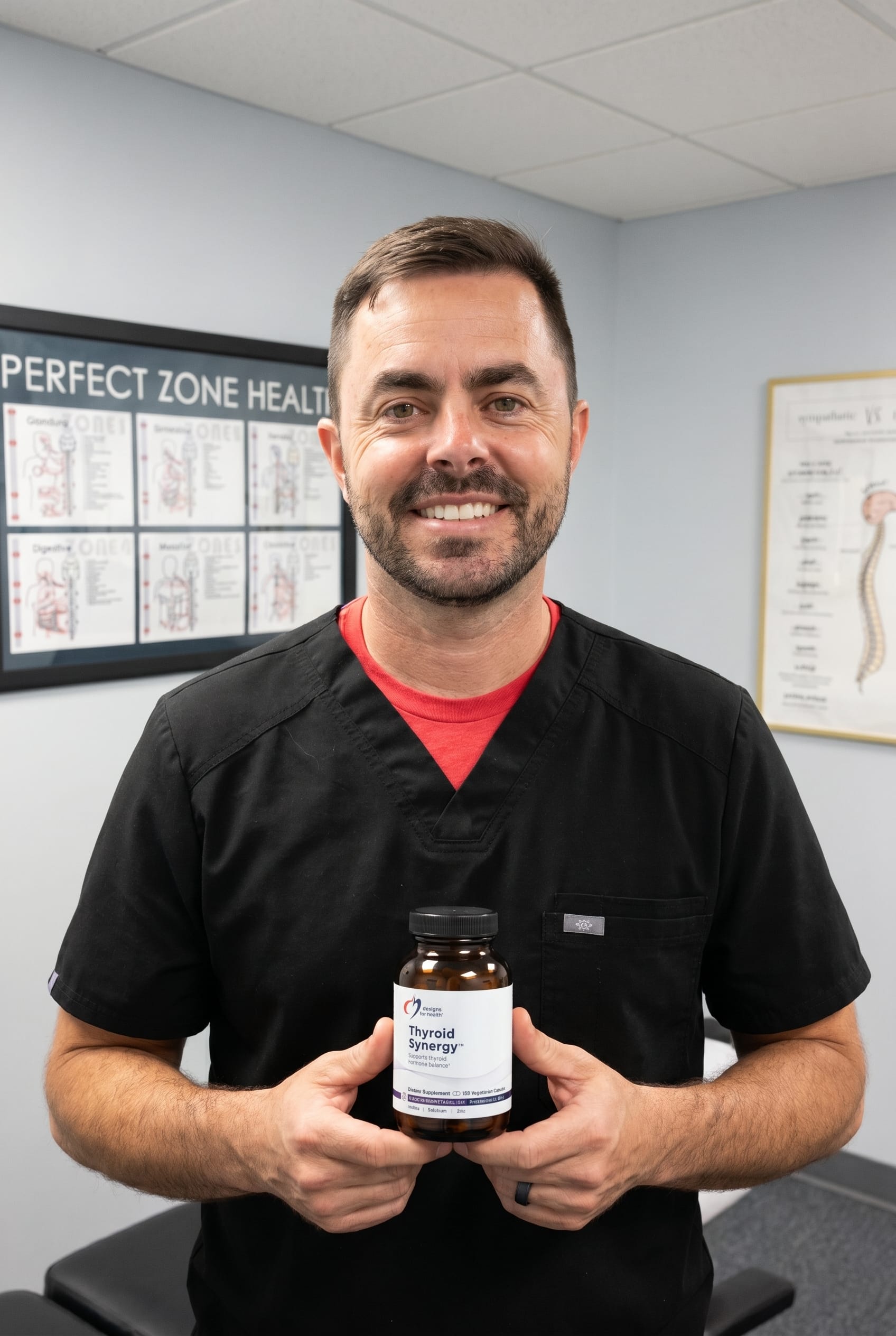
Thyroid Synergy Review by Designs for Health - Dr. Bell
Designs for Health Thyroid Synergy review by Dr. Bell. Multi-nutrient thyroid support with iodine, selenium, zinc, tyrosine, ashwagandha, and forskohlii for subclinical hypothyroidism, fatigue, weight, and thyroid function. Dosing, who benefits, side effects.

A 43-year-old patient came to me describing classic mild hypothyroid symptoms: cold hands and feet, dry skin, slow weight gain over the previous year despite eating the same way, thinning hair around the temples, and a general lack of energy by mid-afternoon. Her primary care doctor had run a TSH, gotten a result of 3.4 (technically "normal," at the high end of the lab range), and told her thyroid was not the problem. Her free T3 had never been checked.
I ran a fuller thyroid panel. Her TSH was 3.4, her free T4 was on the low end of normal, her free T3 was below the optimal range, and her reverse T3 was slightly elevated. Her ferritin (iron stores) was low, which made the T3 conversion even harder. This is the textbook subclinical hypothyroid pattern that gets missed when only TSH is checked.
I started her on Thyroid Synergy, two capsules a day with breakfast, plus iron support for the low ferritin. Within six weeks her symptoms had clearly improved: warmer hands, more energy, less hair thinning. By twelve weeks her repeat labs showed her free T3 in the optimal range and her reverse T3 normalized. Her TSH had dropped to 1.8.
Quick verdict: Thyroid Synergy is the nutrient blend I reach for when patients have subclinical hypothyroid patterns, classic hypothyroid symptoms with "normal" TSH, mild Hashimoto's, or post-diet metabolic slowdown.
Order Thyroid Synergy →What this product is actually doing
Your thyroid gland produces two main hormones: T4 (the storage form) and a small amount of T3 (the active form). Most of the T3 in your body is actually converted from T4 in peripheral tissues (liver, kidney, muscle, gut). The conversion requires specific nutrients: selenium, zinc, iron, tyrosine, and B vitamins. When any of these are short, the conversion stalls, and you can have a "normal" TSH while feeling like your thyroid is sluggish.
Thyroid Synergy supplies the full nutrient stack that supports both the thyroid gland itself and the peripheral conversion. Iodine is required for T4 synthesis. Selenium is the cofactor for the deiodinase enzyme that converts T4 to T3 (and it also protects the thyroid from autoimmune damage). Zinc supports both thyroid hormone synthesis and conversion. Tyrosine is the amino acid backbone of thyroid hormone. Ashwagandha and forskohlii have both been studied for mild support of thyroid function (especially in subclinical hypothyroidism).
This is a nutritional support product, not a thyroid hormone replacement. Patients with overt hypothyroidism (TSH above 10, or symptomatic with TSH 5 to 10 plus positive antibodies) need a prescription thyroid hormone, not just nutrients. But for the much larger group of patients with subclinical hypothyroid patterns and nutrient gaps, this product can move the labs and the symptoms.
What is in Thyroid Synergy
Two capsules (the daily clinical dose) contain:
- Iodine (from potassium iodide), 150 mcg (one full RDA)
- Selenium (selenomethionine), 200 mcg
- Zinc, 15 mg
- Copper, 1 mg (for balanced zinc absorption)
- L-tyrosine, 500 mg
- Ashwagandha root extract (KSM-66), 250 mg
- Forskolin (Coleus forskohlii root extract), 50 mg
- Vitamin A (as retinyl palmitate and beta-carotene), 1,500 IU
- Vitamin B2 (riboflavin), 5 mg
- Vitamin B3 (niacinamide), 25 mg
- Vitamin B6 (P5P), 5 mg
The iodine dose is conservative on purpose. Patients with autoimmune thyroid disease (Hashimoto's) can flare on high-dose iodine, which is why this product uses just 150 mcg (one daily requirement) rather than the much higher doses found in some other thyroid formulas. The selenium at 200 mcg has been shown in studies to reduce thyroid antibodies in Hashimoto's patients.
The KSM-66 ashwagandha is the most-studied extract for subclinical hypothyroid support. In one trial, it raised T4 and T3 modestly in patients with subclinical hypothyroidism over 8 weeks.
Who tends to do well on Thyroid Synergy
The pattern that responds best:
- Subclinical hypothyroidism (TSH 2.5 to 4.5, with symptoms; free T3 on the lower end)
- Patients with normal TSH but classic hypothyroid symptoms (cold, dry skin, hair thinning, fatigue, weight gain)
- Hashimoto's patients with mild disease who are not yet on prescription medication (with their prescriber's input)
- Patients on stable levothyroxine who still have residual symptoms and low free T3 (selenium and zinc can support better conversion)
- Perimenopausal women with hypothyroid symptoms
- Patients who have lost weight rapidly and ended up with a low-T3 pattern
- Athletes with overtraining symptoms and a low free T3
- Patients on a long-term low-calorie diet with metabolic slowdown
- Anyone with a documented selenium deficiency on testing
Who should skip it
- Overt hypothyroidism (TSH greater than 10): you need a prescription thyroid hormone, not a nutrient blend
- Hyperthyroidism or Graves disease (the iodine, tyrosine, and ashwagandha can flare hyperthyroid)
- Active autoimmune thyroid disease where iodine has previously caused a flare
- Pregnant or nursing women (without your prescriber's input; prenatal vitamins usually cover iodine and selenium)
- Patients on warfarin (the vitamin K from some thyroid herbs can interact; not a major issue with this formula but worth knowing)
- People with severe seafood/shellfish allergy (iodine source varies by product, but worth confirming)
- Patients on lithium (the iodine can interact)
- People on amiodarone (already has very high iodine load)
- Patients with active heart arrhythmias (tyrosine and forskohlii can be stimulating)
Buy Thyroid Synergy Direct from DFH
Practitioner pricing is applied automatically at checkout. Every bottle ships direct from the Designs for Health warehouse with full quality control. The same product DFH stocks on its own shelves, at the practitioner price tier.
Shop Thyroid Synergy →How to take it
Two capsules a day with breakfast. The tyrosine and ashwagandha can feel mildly energizing, so morning dosing is preferred. Some patients split the dose (one at breakfast, one at lunch) to avoid feeling over-stimulated.
Take at least 4 hours away from prescription thyroid medication. Selenium, zinc, and other minerals can bind to levothyroxine and reduce its absorption. The standard rule is thyroid medication on an empty stomach in the morning, supplements with breakfast a few hours later.
Take with food. The vitamin A and the herbs are better tolerated with a meal.
Allow 8 to 12 weeks for the full effect. Thyroid hormone half-life is about a week for T4, and tissue effects take longer than that. Recheck labs at 12 weeks.
What to expect
- Weeks 1 to 2: most patients do not feel a dramatic change yet. Some notice slightly more morning energy.
- Weeks 3 to 6: cold hands and feet often warm up. Skin hydration improves. Hair shedding slows. Mood and energy steady.
- Weeks 8 to 12: full effect in responders. Free T3 often moves into the optimal range on follow-up labs. TSH may drop slightly.
- 3 to 6 months: full integration. Body composition slowly improves in patients who also adjust diet and exercise.
- If you stop: thyroid markers can drift back toward baseline over weeks to months. Patients with chronic patterns usually need long-term nutritional support.
Side effects
- Mild over-stimulation, jitteriness, or sleep disruption from the tyrosine or ashwagandha. Drop to one capsule a day.
- Heart palpitations in sensitive patients (especially if there is an undiagnosed hyperthyroid pattern). Stop and get labs.
- GI upset (nausea, loose stool, gas) from the zinc on an empty stomach. Take with food.
- Headache in the first few days.
- Thyroid flare in some Hashimoto's patients from the iodine. Monitor antibodies if you have known Hashimoto's.
- Allergic reaction in patients with ashwagandha or nightshade sensitivity (ashwagandha is in the nightshade family).
- Possible drug interactions with thyroid medication, lithium, amiodarone, and some psychiatric medications.
What I do not love about it
The iodine at 150 mcg is the conservative choice for autoimmune patients, but some patients with goiter or pure iodine-deficient hypothyroidism may need a higher iodine dose (kelp-based products provide 300 to 1,000 mcg). For those patients, I supplement separately.
The ashwagandha is in the nightshade family, which means a small subset of patients with nightshade sensitivity react to it. If a patient has joint pain or fatigue that flares on tomatoes or peppers, ashwagandha can be a problem too. For those patients I switch to a non-nightshade thyroid formula.
And: thyroid support without addressing iron status, gut absorption, sleep, or chronic stress only gets you partway. The thyroid gland sits downstream of those other systems. A patient with severe iron deficiency or active gut inflammation will not see the full benefit of this product until those upstream issues are addressed.
For background, see the PMC trial on ashwagandha for subclinical hypothyroidism, the PMC review on selenium and thyroid function, and the NIH ODS fact sheet on iodine.
Bottom line
Thyroid Synergy is the nutrient blend I reach for when patients have subclinical hypothyroid patterns, classic hypothyroid symptoms with "normal" TSH, mild Hashimoto's, or post-diet metabolic slowdown. The blend of iodine, selenium, zinc, tyrosine, ashwagandha, and B vitamins supports both thyroid hormone production and the peripheral conversion of T4 to T3. Two capsules a day with breakfast, taken at least 4 hours away from prescription thyroid medication. Allow 8 to 12 weeks.
Always check with a healthcare provider before starting any new supplement, especially if you have a known thyroid condition, take thyroid medication, lithium, or amiodarone, or have an active autoimmune disease.
← See all hormone health reviews by Dr. Bell
Ready to try Thyroid Synergy?
It is one I trust enough to use with my own patients and order for my family. Through my DFH store you get the authentic, direct-from-manufacturer product with practitioner pricing applied automatically at checkout.
Order Thyroid Synergy →Authentic, direct from Designs for Health · practitioner pricing · no third-party counterfeits
About the Author: Dr. Bell
Dr. Bell is a chiropractor and holistic wellness practitioner at Dr. Bell Health. He writes plain-language reviews of Designs for Health supplements based on years of clinical experience. Read more about Dr. Bell.