Trifolamin Review by Designs for Health - Dr. Bell
Designs for Health Trifolamin review by Dr. Bell. Sublingual lozenge combining methylcobalamin B12, methylfolate, and pyridoxal-5-phosphate B6 for homocysteine, methylation, and MTHFR support. Dosing, who benefits, side effects.

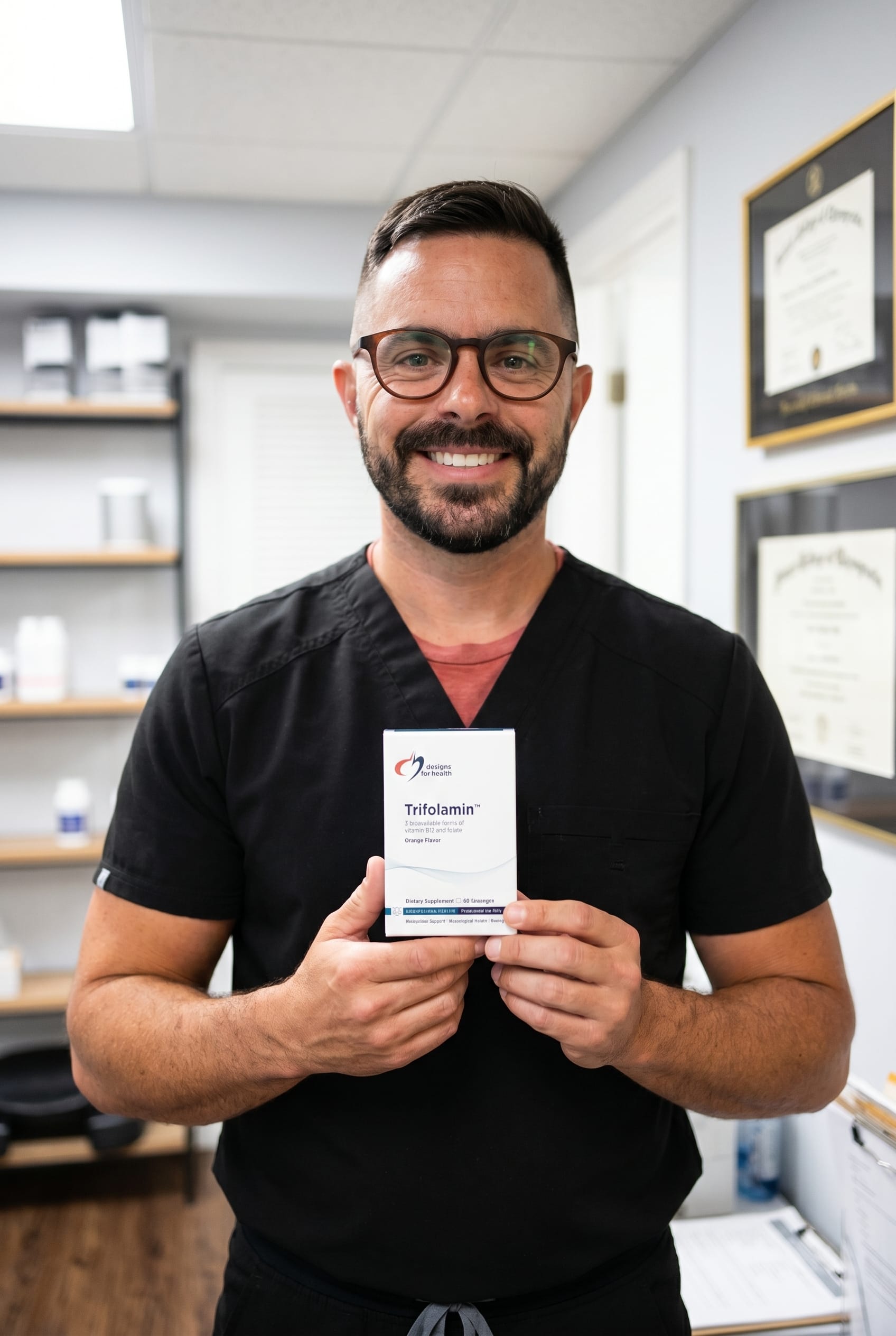
A 58-year-old retired teacher came to me with a fasting homocysteine of 18. Her primary care doctor had told her not to worry about it, but the number bothered her because her father had a stroke in his sixties. She also reported foggy thinking in the afternoons, mild numbness in her left foot, and a flat mood she described as "fine but not really fine." Her B12 was at 280, which is technically normal but on the low end of a range many countries would call deficient.
I put her on Trifolamin, one lozenge a day under the tongue. Three months later her homocysteine had dropped to 9, the foot numbness was gone, and her afternoons felt clear again. She told me the flat feeling had lifted by the end of week three.
Trifolamin is the three-vitamin sublingual lozenge I reach for when a patient needs serious methylation support and a real drop in homocysteine. The combination of methylcobalamin, methylfolate, and active B6 is what the body actually uses to clear homocysteine and run the methylation cycle, and the sublingual route gets all three past a sluggish gut.
Quick verdict: Trifolamin is the sublingual three-vitamin lozenge I use for patients who need real methylation support: elevated homocysteine, MTHFR variants, mild fatigue and mood symptoms, family history of cardiovascular disease, vegetarian diets, long-term acid-blocker or metformin use, and adults over 50 who feel a step slower than they should.
Order Trifolamin →What this product is actually doing
Methylation is one of the most important chemical reactions in your body. It happens billions of times a second and it controls things you would not expect: how DNA gets repaired, how neurotransmitters are made and recycled, how your body detoxifies hormones and chemicals, and how homocysteine is cleared from the blood. Homocysteine is a sulfur-containing amino acid that builds up when methylation is broken. High homocysteine is associated with cardiovascular disease, stroke, dementia, and depression.
The methylation cycle runs on three vitamins above all others: B12, folate, and B6. When any one of those is low, or when you carry an MTHFR variant that slows down the conversion of standard folic acid into its active form, the whole cycle stutters. Homocysteine climbs. Energy drops. Brain function gets foggy. Mood flattens. Numbness or tingling can show up in the hands and feet because the nerves are not getting the methyl donors they need.
Trifolamin delivers the active forms of all three of these vitamins in a single lozenge that dissolves under the tongue. It does not depend on stomach acid, intact gut absorption, or efficient enzymatic conversion to work. For patients with MTHFR variants, low stomach acid, long-term acid-blocker use, or just an inefficient methylation cycle, this is the dose form that actually hits the target.
What is in Trifolamin
Each lozenge contains:
- Vitamin B12 (as methylcobalamin), 1,000 mcg
- Folate (as L-5-MTHF, Quatrefolic brand), 800 mcg DFE
- Vitamin B6 (as pyridoxal-5-phosphate, P5P), 10 mg
1,000 mcg of methylcobalamin is a solid maintenance dose. It is lower than the 5,000 mcg in Ultra B12-Folate, which makes Trifolamin a better fit for patients who do not need the highest possible B12 saturation but do need real methylation support every day.
The methylfolate at 800 mcg matches the folate dose in Ultra B12-Folate. This is the active form of folic acid that your cells can use directly, with no MTHFR conversion required.
The pyridoxal-5-phosphate at 10 mg is the active form of B6. Standard pyridoxine HCl B6 needs to be converted in the liver before your cells can use it, and some patients (especially those with liver issues or genetic variants in the conversion enzymes) do that conversion poorly. P5P is the form that goes straight to work.
The lozenge dissolves under the tongue. The mucous membranes of the mouth are richly vascularized, which means the vitamins absorb directly into the bloodstream and bypass the gut entirely.
Who tends to do well on Trifolamin
The pattern that responds best:
- Elevated homocysteine (anything over 9 to 10 is worth treating)
- Family history of stroke, heart attack, or early-onset dementia
- MTHFR C677T or A1298C variants
- Adults over 50 with foggy thinking, low energy, or low mood
- Vegetarians and vegans (B12 only comes from animal foods or supplements)
- Patients on long-term proton pump inhibitors or H2 blockers
- Long-term metformin users (metformin depletes B12)
- Patients on anticonvulsants that deplete folate (phenytoin, carbamazepine)
- Women planning a pregnancy (active folate is important from before conception)
- Adults with peripheral neuropathy, tingling, or restless legs
- People with mild depression and normal thyroid (B vitamins matter for neurotransmitter synthesis)
- Patients with elevated MMA (methylmalonic acid) on labs (a sensitive marker for B12 deficiency)
- Anyone post-bariatric surgery, especially gastric bypass
Who should skip it
- Active cancer patients should coordinate with their oncologist. Folate is a growth signal for some cancer cell lines.
- Patients on methotrexate (folate can interfere with the drug's mechanism)
- Pregnant women should coordinate with their prenatal provider so total folate intake is appropriate
- Patients with Leber's hereditary optic neuropathy (rare; check with prescriber)
- People who feel anxious, jittery, or wired on B vitamins (some methylation-sensitive patients overshoot at this dose)
- Severe cobalt allergy
- Patients on Parkinson's medications like levodopa (B6 can reduce levodopa effectiveness if not taken with carbidopa)
Trifolamin Direct from the Manufacturer
Most supplements are heat- and humidity-sensitive, and potency drops fast in a third-party warehouse. Buying through my DFH store means your bottle goes from their climate-controlled facility straight to your door, at practitioner pricing.
Order Trifolamin →How to take it
One lozenge a day, dissolved slowly under the tongue. Do not chew or swallow it whole. Let it sit there for 5 to 10 minutes while it slowly dissolves. The longer the contact time with the mucous membranes, the more vitamins absorb directly.
Timing: morning or midday is fine. Most patients do not feel a stimulating effect, but if you do, avoid taking it within a few hours of bedtime.
For patients with elevated homocysteine, one lozenge a day for 8 to 12 weeks usually drops the number significantly. Recheck homocysteine after 12 weeks and adjust from there.
For long-term methylation support in patients with MTHFR variants or chronic risk factors, one lozenge a day or every other day is reasonable indefinitely.
For patients who need higher B12 (frank deficiency, post-bariatric surgery, severe absorption issues), Ultra B12-Folate at 5,000 mcg is the better choice. Trifolamin is the "methylation maintenance" version with a balanced three-vitamin approach.
What to expect
- Weeks 1 to 2: most patients do not feel a dramatic change yet. Some methylation-sensitive patients notice clearer thinking or a mood lift within days.
- Weeks 3 to 6: energy, focus, and mood often improve. Numbness or tingling from low B12 starts to ease.
- Weeks 8 to 12: homocysteine drops meaningfully on follow-up labs. A starting number of 15 often falls to 8 or 9 in this window.
- Months 3 to 6: nerve symptoms continue to improve (peripheral nerves heal slowly). Cardiovascular risk markers stabilize.
- If you stop: B vitamins are water-soluble and not stored long-term in the way B12 alone is. Homocysteine can climb again within a few weeks to months in patients with MTHFR variants.
Side effects
- Very well tolerated for most people. The B vitamins have an excellent safety profile.
- Mild stimulation, anxiety, or insomnia in methylation-sensitive patients. Drop to half a lozenge or every other day.
- Headache in the first few days, occasionally. Often resolves.
- B6 at higher long-term doses (over 100 mg/day for months) can cause peripheral neuropathy. The 10 mg in Trifolamin is well below that risk threshold.
- Mild acne flare on high-dose B12 in a small number of patients
- Drug interactions: methotrexate, levodopa without carbidopa, phenytoin, certain antibiotics
- Rare cobalt allergy
What I do not love about it
For patients with frank B12 deficiency on labs (B12 under 200, elevated MMA, classic neurologic symptoms), 1,000 mcg of methylcobalamin per day is not enough to fully replete in a reasonable time frame. Those patients should be on Ultra B12-Folate at 5,000 mcg or even on a course of intramuscular B12 injections under their prescriber's care. Trifolamin is maintenance and prevention, not aggressive repletion.
The other small thing: there is no B6 buffer in Trifolamin. Patients with high B6 already (some get this from food and a multivitamin combined) can overshoot. Check your total intake from all sources if you take a multivitamin too.
And one more: as with any methylated B vitamin, a subset of patients (sometimes called overmethylators or methylation-sensitive) feel worse on this rather than better. They get anxious or wired. The fix is to start at a much lower dose, address the rest of the methylation pathway (B2, magnesium, glycine, balanced amino acids), and work back up slowly.
For more on the methylation cycle and B vitamin biology, see the PMC review on methylation and homocysteine metabolism and the NIH Office of Dietary Supplements fact sheet on B12.
Bottom line
Trifolamin is the sublingual three-vitamin lozenge I use for patients who need real methylation support: elevated homocysteine, MTHFR variants, mild fatigue and mood symptoms, family history of cardiovascular disease, vegetarian diets, long-term acid-blocker or metformin use, and adults over 50 who feel a step slower than they should. The active forms of B12, folate, and B6 in a sublingual lozenge bypass the gut and the conversion bottlenecks. One lozenge a day for 8 to 12 weeks, then recheck homocysteine and adjust.
Always check with a healthcare provider before starting any new supplement, especially if you take prescription medication or have a personal or family history of cancer.
← See all vitamins and minerals reviews by Dr. Bell
Ready to try Trifolamin?
It is one I trust enough to use with my own patients and order for my family. Through my DFH store you get the authentic, direct-from-manufacturer product with practitioner pricing applied automatically at checkout.
Order Trifolamin →Authentic, direct from Designs for Health · practitioner pricing · no third-party counterfeits
About the Author: Dr. Bell
Dr. Bell is a chiropractor and holistic wellness practitioner at Dr. Bell Health. He writes plain-language reviews of Designs for Health supplements based on years of clinical experience. Read more about Dr. Bell.