Ultra B12-Folate Review by Designs for Health - Dr. Bell
Designs for Health Ultra B12-Folate review by Dr. Bell. High-dose methylcobalamin and methylfolate lozenge for energy, MTHFR support, methylation, and mood. Dosing, who benefits, side effects.

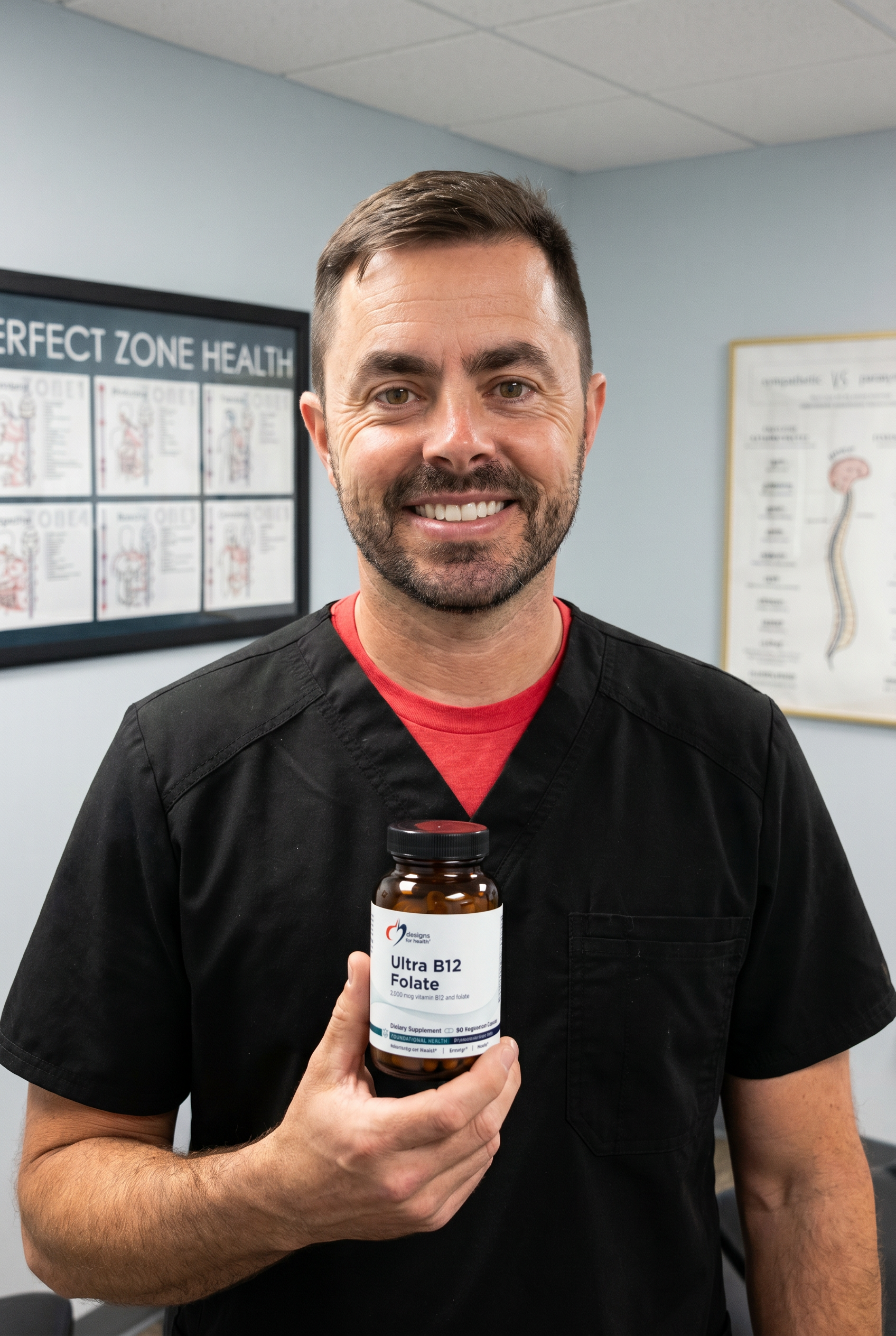
A 44-year-old woman came in dragging. Tired in the morning, tired in the afternoon, dragging through the gym, and feeling vaguely flat in her mood. Her bloodwork looked unremarkable to her primary care doctor, but I pulled her B12 and folate levels and they sat at the low end of normal. She also carried two copies of the MTHFR C677T variant, which I had tested years before for a different reason.
I started her on Ultra B12-Folate, one lozenge a day under the tongue. Within two weeks she was sleeping better and felt sharper in the morning. Within six weeks her gym sessions were back to normal intensity, and the low-grade gray feeling in her mood had lifted. Her follow-up labs at four months showed her B12 had climbed from the low end of normal to the upper third.
B12 deficiency is one of the most underdiagnosed deficiencies in adults, and the standard tests miss a lot of it. For patients with MTHFR variants, malabsorption, vegetarian diets, long-term acid blocker use, or just unexplained fatigue, the right form of B12 paired with the right form of folate often does more than it should.
Quick verdict: Ultra B12-Folate is the high-dose, active-form sublingual B12 plus methylfolate I use for patients with unexplained fatigue, low-normal B12, MTHFR variants, vegetarian or vegan diets, long-term acid blocker or metformin use, and post-bariatric absorption issues.
Order Ultra B12-Folate →Why "normal" B12 is often not enough
The normal range for serum B12 in the US runs from about 200 to 900 pg/mL. Many countries set the lower bound much higher (300 to 350) because patients with B12 in the 200-300 range often have functional symptoms even though the lab calls it normal. So the first issue is that the test cutoff is loose.
The second issue is that B12 has to be converted to its active forms (methylcobalamin and adenosylcobalamin) before your cells can use it. The B12 in most multivitamins and drug-store supplements is cyanocobalamin, which is cheap and stable but has to be converted by your body. Patients with MTHFR variants, gut malabsorption, or certain medications often do not convert it well. They look like they are taking B12 but their cells are still functionally deficient.
Ultra B12-Folate solves both problems. The B12 is already in the methylcobalamin form (the active form), and the folate is methylfolate (also the active form). For people who do not convert efficiently, this is the form their cells can actually use. The lozenge also bypasses the gut, which matters for patients with absorption issues.
What is in Ultra B12-Folate
Each lozenge contains:
- Vitamin B12 (as methylcobalamin), 5,000 mcg
- Folate (as L-5-MTHF, Quatrefolic brand), 800 mcg DFE
5,000 mcg of methylcobalamin is a clinical dose. It is much higher than the RDA, but B12 has an excellent safety profile and high-dose B12 is the standard approach for known deficiency, MTHFR variants, and elderly patients with absorption issues. The body takes what it needs and excretes the rest.
The methylfolate at 800 mcg is the active form of folic acid and is essential for the methylation cycle. Folic acid (the synthetic form in most fortified foods and cheap supplements) needs to be converted by an enzyme called MTHFR. People with MTHFR variants convert poorly. Skipping straight to methylfolate sidesteps the bottleneck.
The lozenge dissolves under the tongue, which means the B12 absorbs through the lining of the mouth directly into the bloodstream. This is important for patients with gastric atrophy, low stomach acid, long-term proton pump inhibitor use, or post-bariatric surgery, all of whom struggle to absorb oral B12 through the gut.
Who tends to do well on Ultra B12-Folate
The pattern that responds best:
- Unexplained fatigue with B12 at the low end of normal
- MTHFR C677T or A1298C variants (one copy or two)
- Vegetarians and vegans (B12 is only available from animal foods, fortified products, or supplements)
- Adults over 50 (gastric acid declines with age, making oral B12 absorption harder)
- Long-term users of acid-blocking medications (PPIs like omeprazole, H2 blockers like famotidine)
- Long-term metformin users (metformin depletes B12)
- Post-bariatric surgery patients (gastric bypass especially)
- Patients with chronic alcohol use or recovery (alcohol depletes B vitamins)
- Pregnancy planning (folate matters before conception and in the first trimester)
- Patients with restless legs syndrome, neuropathy, or tingling in the hands and feet (low B12 is a known driver)
- Mild depression and mood symptoms with normal thyroid (B12 and folate both contribute to methylation and neurotransmitter synthesis)
- People recovering from a long viral illness or significant stress
Who should skip it
- Patients with active cancer should coordinate with their oncologist. Folate is a growth signal for some cancer cells, and timing matters.
- Anyone with Leber's hereditary optic neuropathy (a rare mitochondrial disease; high-dose B12 in cyanocobalamin form is contraindicated, and methylcobalamin should be checked with prescriber)
- People on methotrexate (folate can interfere with the drug's mechanism). Talk to your prescriber.
- Pregnancy: folate is essential, but the dose should be coordinated with your prenatal provider. Some women need extra; some are already getting enough.
- Severe allergic reaction to cobalt (rare)
- People who feel anxious or wired on B vitamins (a small subset of methylation-sensitive patients should start at a lower dose)
Save on Ultra B12-Folate with Practitioner Pricing
Below standard retail with practitioner pricing applied to every order. No memberships, no minimums, no hoops to jump through. Just direct-from-DFH shipping with my practitioner discount built into the price.
Get Ultra B12-Folate →How to take it
One lozenge a day, dissolved slowly under the tongue. Do not chew it or swallow it whole. Let it sit there for 5 to 10 minutes while it dissolves. The longer it stays in contact with the mucous membranes, the more absorbs directly through the lining of the mouth.
Timing: morning or midday is fine. Some patients feel a slight energy boost from B12, so I would not take it right before bed if you are sensitive.
For diagnosed B12 deficiency, the dose may need to go higher (one lozenge twice a day) for the first few months under a prescriber's guidance, then drop back to once a day.
For pure maintenance in a healthy adult, every other day is often enough. The body stores B12 for months, so you do not need a hard daily schedule.
What to expect
- Days 1 to 7: most patients do not feel a dramatic change yet. Some methylation-sensitive patients feel a noticeable mood lift or burst of energy within days.
- Weeks 2 to 4: energy and mental clarity often improve. Sleep quality often improves as a side benefit.
- Weeks 4 to 8: mood, focus, and stamina settle into a new steady state. Tingling or numbness from low B12 starts to improve (though full nerve recovery can take many months).
- 3 to 6 months: serum and intracellular B12 fully replete. Most patients can then maintain on every other day or every third day.
- If you stop: the body's stores last for months, so the effect fades slowly.
Side effects
- Very well tolerated for most people. B12 has one of the cleanest safety profiles of any vitamin.
- Mild stimulation or anxiety in methylation-sensitive patients. Drop to half a lozenge or every other day.
- Headache in the first few days, rare. Often resolves.
- Mild acne flare in some patients (high-dose B12 is occasionally associated with this)
- Rare allergic reaction to cobalt (B12 contains a cobalt atom)
- Drug interactions: methotrexate, certain seizure medications, chloramphenicol
What I do not love about it
For a small subset of patients with what is sometimes called methylation-sensitivity (the same patients who do not tolerate high-dose methyl donors well), 5,000 mcg is too much. They feel anxious, wired, or irritable on it. The solution is to start at half a lozenge or every other day, and to make sure the rest of the methylation supports (B6, magnesium, glycine) are also in place. But it is one more nuance for patients to navigate.
The other thing: the test for MTHFR variants is helpful for understanding which patients are likely to benefit, but it is not a strict requirement. Many of my patients with classic symptoms (fatigue, mood, neuropathy, low B12 on labs) respond regardless of their MTHFR status. The variant matters more for fine-tuning than for making the call.
Finally: this is a high-dose product designed for clinical use. If you just want a daily multivitamin with B12, this is overkill. The full-strength formula is intended for people who actually need it, not for general wellness.
Bottom line
Ultra B12-Folate is the high-dose, active-form sublingual B12 plus methylfolate I use for patients with unexplained fatigue, low-normal B12, MTHFR variants, vegetarian or vegan diets, long-term acid blocker or metformin use, and post-bariatric absorption issues. The lozenge route bypasses the gut and the methylcobalamin form bypasses the conversion bottleneck. One lozenge a day, dissolved slowly under the tongue, for 8 to 12 weeks to start.
Always check with a healthcare provider before starting any new supplement, especially if you take prescription medication or have a history of cancer.
← See all vitamins and minerals reviews by Dr. Bell
Ready to try Ultra B12-Folate?
It is one I trust enough to use with my own patients and order for my family. Through my DFH store you get the authentic, direct-from-manufacturer product with practitioner pricing applied automatically at checkout.
Order Ultra B12-Folate →Authentic, direct from Designs for Health · practitioner pricing · no third-party counterfeits
About the Author: Dr. Bell
Dr. Bell is a chiropractor and holistic wellness practitioner at Dr. Bell Health. He writes plain-language reviews of Designs for Health supplements based on years of clinical experience. Read more about Dr. Bell.