C3 Curcumin Complex Review by Designs for Health - Dr. Bell
Designs for Health C3 Curcumin Complex review by Dr. Bell. Standardized 95% curcuminoids with BioPerine black pepper for joint pain, inflammation, arthritis, and recovery. Dosing, who benefits, side effects.

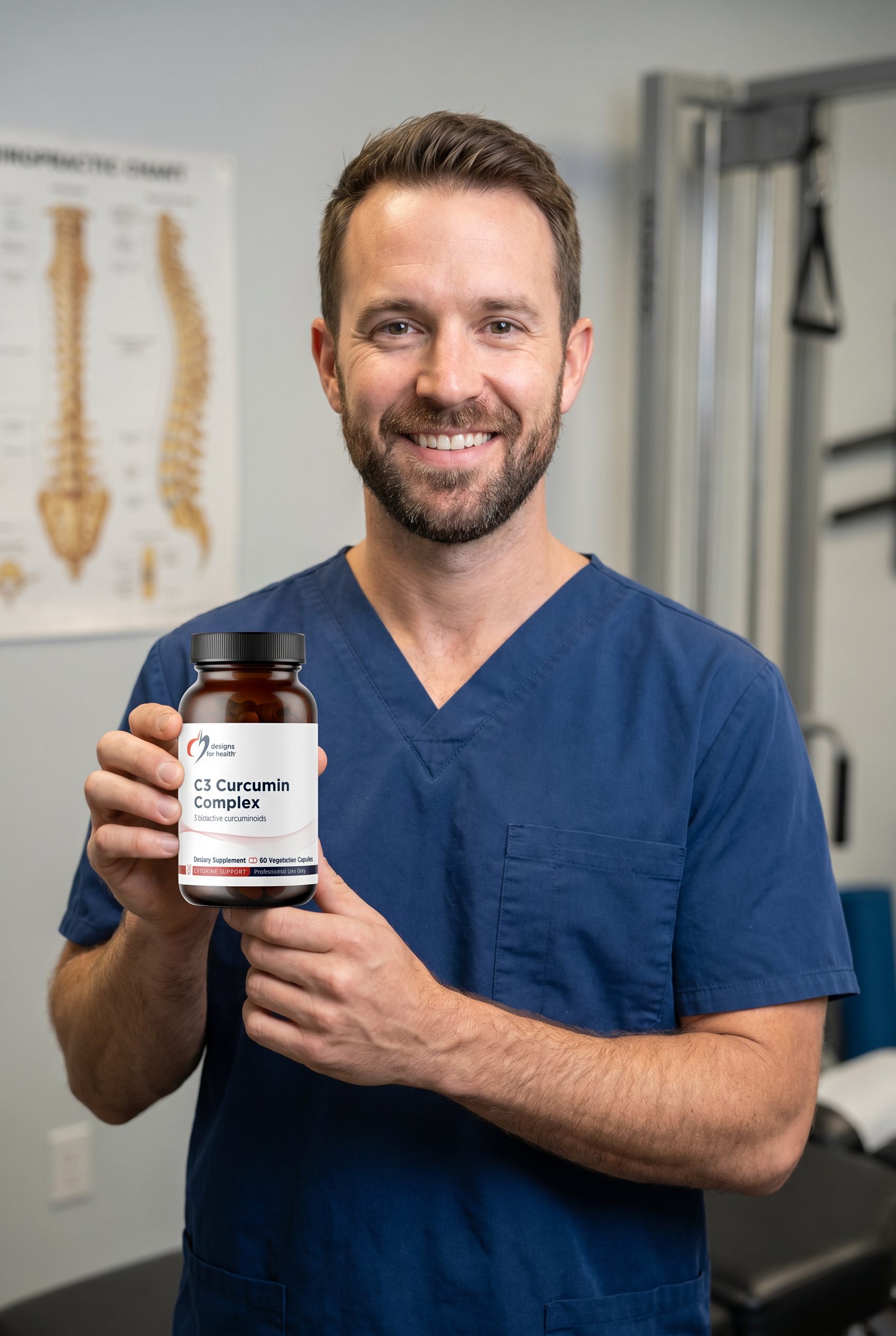
A 57-year-old patient came to me with knee pain that had built up over a decade. He had played college soccer, run marathons in his thirties, and was now dealing with mild osteoarthritis. He had been taking 600 mg of ibuprofen most days for the last year, which helped the pain but had started causing reflux and the occasional dark stool. His gastroenterologist had told him he needed to find another approach.
I started him on C3 Curcumin Complex, two capsules twice a day with meals. Within four weeks his daily knee pain had dropped noticeably and he had cut his ibuprofen in half. By eight weeks he was off ibuprofen entirely on most days. The reflux resolved within two weeks of stopping the daily NSAID, and his knees were the best they had felt in five years.
Curcumin is the active anti-inflammatory compound in turmeric. The research on it is some of the most robust in herbal medicine: dozens of randomized controlled trials across arthritis, post-surgical recovery, depression, and inflammatory bowel disease have shown meaningful effect sizes. The problem with curcumin has always been absorption. C3 Curcumin Complex pairs the well-studied C3 curcuminoid extract with BioPerine (a black pepper extract) to boost absorption by up to 2,000%.
Quick verdict: C3 Curcumin Complex is the curcumin product I reach for when patients have mild to moderate joint pain, osteoarthritis, chronic NSAID use they want to taper, post-injury recovery, inflammatory bowel patterns, or elevated inflammation markers.
Order C3 Curcumin Complex →What this product is actually doing
Curcumin works by blocking several pro-inflammatory pathways in the body, including NF-kB (a master regulator of inflammation), COX-2 (the same enzyme NSAIDs block, but more gently and without the gut damage), and TNF-alpha. The end effect is reduced inflammation throughout the body, which translates clinically into less joint pain, lower CRP, better recovery from exercise, and (in some studies) improvements in mood and cognition.
The challenge is that curcumin by itself is absorbed poorly. Less than 1% of an oral dose typically makes it into the bloodstream. This is why turmeric in food, while healthful, does not produce the clinical effects you see in research trials that use standardized extracts. To make curcumin work as a supplement, you need either (a) a high dose, (b) an absorption enhancer like piperine or phospholipid binding, or (c) both.
C3 Curcumin Complex uses the most-studied curcuminoid extract on the market (Curcumin C3 Complex from Sabinsa, 95% standardized curcuminoids) and pairs it with BioPerine (a patented black pepper extract that contains piperine). Piperine inhibits the enzymes that break down curcumin in the gut and liver, which dramatically increases how much active curcumin reaches the bloodstream. The combination has been studied extensively and is the gold standard for piperine-enhanced curcumin formulas.
What is in C3 Curcumin Complex
One capsule contains:
- Curcumin C3 Complex (95% curcuminoids), 400 mg
- BioPerine (black pepper extract, 95% piperine), 5 mg
The C3 Complex is a blend of three curcuminoids: curcumin (about 75%), demethoxycurcumin (about 15%), and bisdemethoxycurcumin (about 5%). The blend is more biologically active than pure isolated curcumin because the three molecules work synergistically.
The piperine dose at 5 mg is well-tolerated and effectively boosts curcumin absorption. Some products use higher piperine doses, but 5 mg per capsule is the sweet spot for absorption enhancement without raising the risk of drug interactions.
The capsules are vegetarian. The total daily dose at four capsules is 1,600 mg of curcuminoids, which is in line with the doses used in clinical trials for joint pain and inflammation.
Who tends to do well on C3 Curcumin Complex
The pattern that responds best:
- Mild to moderate osteoarthritis (knee, hip, hands, spine)
- Rheumatoid arthritis as an adjunct to prescription DMARDs
- Chronic low back pain with an inflammatory component
- Tendinitis and post-injury recovery
- Patients trying to taper off chronic NSAID use
- Post-surgical recovery (under your surgeon's input)
- Athletes with high training volume and recovery needs
- Patients with elevated hs-CRP or other inflammation markers
- Mild inflammatory bowel disease (ulcerative colitis, mild Crohn's) as an adjunct
- Patients with skin inflammation (eczema, psoriasis) with a systemic component
- Mild to moderate depression with an inflammatory component
- Type 2 diabetes adjunct (curcumin has modest blood sugar effects)
Who should skip it
- Patients on warfarin or other blood thinners (curcumin has mild blood-thinning effects; coordinate with prescriber)
- People with active bleeding disorders
- Patients scheduled for surgery within the next 2 weeks
- Patients with active gallbladder disease, gallstones, or bile duct obstruction (curcumin stimulates bile flow)
- Pregnant or nursing women without their prescriber's input
- Patients with iron-deficiency anemia (curcumin can mildly reduce iron absorption)
- Severe acid reflux that worsens with herbs
- Patients on tacrolimus or cyclosporine (piperine can raise drug levels significantly)
- People who are on multiple medications metabolized by liver enzymes (piperine inhibits some CYP enzymes; talk to your pharmacist)
Set Up Autoship for C3 Curcumin Complex
If you take this regularly, set up DFH's Autoship and you get an extra discount on top of practitioner pricing, plus free shipping every time. Cancel or change the schedule any time. Set it and forget it.
Start Autoship →How to take it
For active joint pain, mild arthritis, or anti-inflammatory support: two capsules twice a day with meals (4 capsules total, 1,600 mg of curcuminoids daily).
For maintenance and prevention: one capsule twice a day with meals (2 capsules total, 800 mg daily).
For severe inflammation, post-surgical recovery, or acute injury: two capsules three times a day for the first 2 to 4 weeks (6 capsules, 2,400 mg), then drop to a maintenance dose. This higher range should be supervised if the patient is on medications.
Always take with food, ideally a meal that contains some fat. Curcumin is fat-soluble and absorbs better with food.
Allow 4 to 8 weeks to see the full anti-inflammatory effect. Some patients feel improvement within the first 2 weeks, but the cumulative effect on tissue inflammation takes longer.
What to expect
- Weeks 1 to 2: some patients notice less morning stiffness or less recovery time after exercise.
- Weeks 3 to 6: joint pain often eases meaningfully. Inflammation markers like hs-CRP start to drop on labs.
- Weeks 6 to 12: full anti-inflammatory effect. Many patients are able to reduce or stop chronic NSAID use.
- 3 to 6 months: full stabilization. Lab markers settle at a new baseline. Joint function continues to improve in patients who are also doing the lifestyle work (weight loss, exercise, anti-inflammatory diet).
- If you stop: the effect fades over weeks. Joint pain may return.
Side effects
- Very well tolerated for most people.
- Mild stomach upset, gas, or loose stool. Take with food.
- Yellow staining of stool (from the curcumin pigment, harmless)
- Mild blood-thinning effect; pause 1 to 2 weeks before surgery
- Headache in the first few days, occasionally
- Rare allergic reaction (turmeric is in the ginger family; some patients with ginger allergy may cross-react)
- Drug interactions: blood thinners, diabetes medications, blood pressure medications, certain chemotherapy drugs (consult oncologist), tacrolimus, cyclosporine, and medications metabolized by CYP enzymes (the piperine effect)
What I do not love about it
The piperine is what makes this product effective, and it is also what raises the drug-interaction concerns. Piperine inhibits several liver enzymes (CYP3A4, CYP2C9) and can raise blood levels of medications that those enzymes break down. For patients on a single uncomplicated medication, this is rarely an issue. For patients on multiple medications metabolized by the liver, the interaction risk is real and worth checking with a pharmacist.
The other thing: piperine-enhanced curcumin works well for most people, but a subset of patients with reflux or sensitive stomachs find the piperine irritating. For those patients, I switch to a phospholipid-bound curcumin (Curcum-Evail or a Meriva product) that uses a different absorption mechanism without the black pepper.
And: for severe rheumatoid arthritis or other autoimmune joint disease, curcumin is an adjunct, not a replacement. It can reduce flare frequency and severity, but it does not replace DMARDs (disease-modifying drugs) that change the trajectory of the disease.
For background, the PMC review on curcumin and arthritis covers the clinical evidence in joint disease, and the NIH NCCIH summary on turmeric covers the broader picture.
Bottom line
C3 Curcumin Complex is the curcumin product I reach for when patients have mild to moderate joint pain, osteoarthritis, chronic NSAID use they want to taper, post-injury recovery, inflammatory bowel patterns, or elevated inflammation markers. The C3 Curcumin Complex and BioPerine combination is the most-studied piperine-enhanced curcumin formulation on the market and reliably gets active curcumin into the bloodstream. Two capsules twice a day with meals for active issues, one capsule twice a day for maintenance. Allow 4 to 8 weeks for full effect.
Always check with a healthcare provider before starting any new supplement, especially if you take blood thinners, prescription anti-inflammatory medications, or any medication metabolized by the liver.
← See all bones, joints, and muscles reviews by Dr. Bell
Ready to try C3 Curcumin Complex?
It is one I trust enough to use with my own patients and order for my family. Through my DFH store you get the authentic, direct-from-manufacturer product with practitioner pricing applied automatically at checkout.
Order C3 Curcumin Complex →Authentic, direct from Designs for Health · practitioner pricing · no third-party counterfeits
About the Author: Dr. Bell
Dr. Bell is a chiropractor and holistic wellness practitioner at Dr. Bell Health. He writes plain-language reviews of Designs for Health supplements based on years of clinical experience. Read more about Dr. Bell.