GI Revive Review by Designs for Health - Dr. Bell
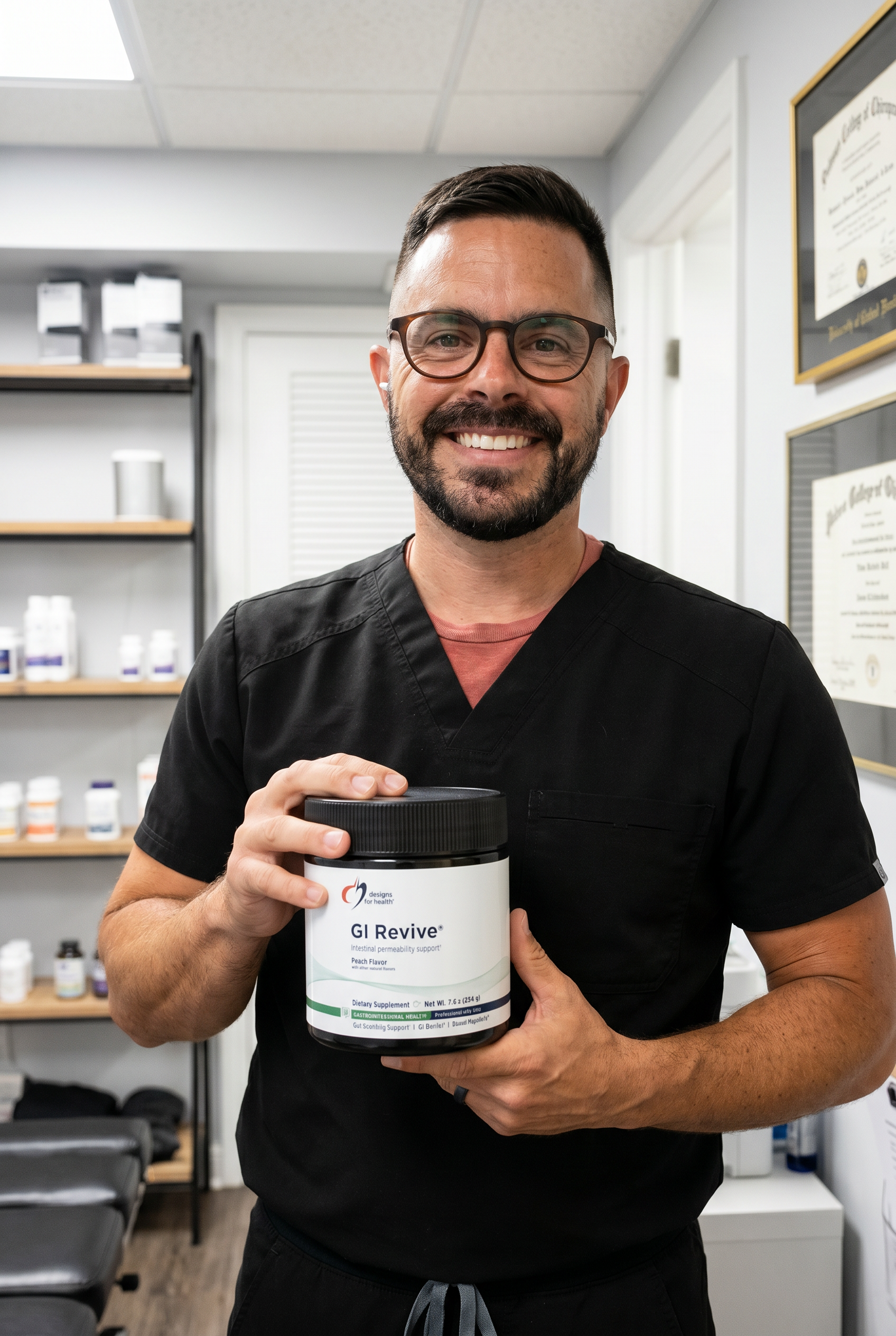
Designs for Health GI Revive review by Dr. Bell. Powdered gut-lining repair blend with L-glutamine, slippery elm, marshmallow root, aloe, zinc carnosine, and DGL for leaky gut, IBS, post-NSAID damage. Dosing, who benefits, side effects.

A 38-year-old runner came to me after a tough year. She had taken ibuprofen daily for nine months while training through plantar fasciitis, then picked up a stomach bug on vacation that turned into three months of bloating, irregular stool, and food sensitivities to things she used to eat without issue. Her gastroenterologist had ruled out everything serious. The diagnosis ended up being "irritable bowel" and the prescription was "manage stress."
I started her on GI Revive powder, one scoop in water at bedtime, on an empty stomach. By week three the bloating was noticeably better. By week eight she could eat the foods that had been triggering her without a reaction. By month four her gut felt like it had before the whole thing started.
The intestinal lining is one of the most regenerative tissues in the body, but it needs the right inputs and a pause from whatever is irritating it. GI Revive is the product I reach for when patients need gut-lining repair, not symptom suppression. The blend has been refined over many years and the ingredients are specifically chosen for their ability to soothe, protect, and rebuild.
Quick verdict: GI Revive Powder is the gut-lining repair product I use for patients with NSAID damage, post-illness gut, leaky gut signs, food sensitivities, IBS bloating, and general intestinal inflammation.
Order GI Revive →What this product is actually doing
Your small intestine has a single layer of cells lining the inside of the tube. That layer is your barrier to the outside world. Every bite of food, every microbe, every chemical you swallow has to pass through (or be turned away by) this one-cell-thick lining. When it works, you absorb nutrients and keep everything else out. When it does not work, undigested food particles and bacterial fragments leak across, which sets off the immune system. This pattern is what people mean when they say leaky gut, and it has been shown in research to play a role in food sensitivities, autoimmune flares, skin conditions, joint pain, and chronic fatigue.
Several things damage this lining: chronic NSAID use (ibuprofen, naproxen), alcohol, food poisoning, infections, long-term stress, broad-spectrum antibiotics, gluten in sensitive patients, and a low-fiber processed-food diet. The damage is usually slow and quiet until the symptoms get loud enough to notice.
GI Revive supplies the building blocks the gut needs to repair itself. L-glutamine is the preferred fuel of the cells that line the small intestine. Slippery elm, marshmallow root, and aloe coat and soothe the inflamed surface. DGL (deglycyrrhizinated licorice) reduces inflammation in the stomach and upper small intestine. Zinc carnosine is the most studied form of zinc for gut-lining repair, with multiple trials showing it heals ulcers and reduces NSAID-induced damage. N-acetyl glucosamine and citrus pectin support the mucus layer that sits above the cell wall.
What is in GI Revive Powder
Each scoop (about 8 grams) delivers a long ingredient list, but the workhorses are:
- L-glutamine, 3 grams (the primary fuel for small intestine cells)
- N-acetyl glucosamine, 1 gram (supports the mucus layer)
- Citrus pectin, 700 mg (gentle soluble fiber and mucus support)
- Deglycyrrhizinated licorice (DGL), 500 mg (anti-inflammatory for stomach lining)
- Aloe vera extract, 250 mg (soothing demulcent)
- Slippery elm bark, 200 mg (coats and protects)
- Marshmallow root, 200 mg (mucilage, anti-irritant)
- Chamomile, cat's claw, methylsulfonylmethane (MSM) at lower doses for added anti-inflammatory support
- Zinc carnosine, 75 mg (gut-lining specific zinc)
- Quercetin and prune powder for added flavonoid and gentle motility support
The powder has a neutral, slightly sweet taste and mixes well in water. It is not gritty if you give it 30 seconds to dissolve. Some patients mix it into a small glass of unsweetened almond milk or a few ounces of apple juice for a more pleasant texture.
Who tends to do well on GI Revive
The pattern that responds best:
- Chronic NSAID users (ibuprofen, naproxen, aspirin)
- Patients post-food-poisoning who never quite recovered
- IBS with bloating, irregular stool, and food sensitivities
- Suspected leaky gut from autoimmune labs, food sensitivity reactions, or skin issues
- Post-antibiotic gut repair (often paired with a probiotic like ProbioMed 100)
- Chronic stress patients with digestive symptoms
- Patients with mild GERD or stomach lining irritation
- Anyone recovering from severe gastroenteritis, C. diff, or norovirus
- Athletes with exercise-induced gut leakiness (a real phenomenon in endurance training)
- Patients with eczema, psoriasis, rosacea, or unexplained joint pain that may have a gut component
- People with food sensitivities that keep expanding (new foods becoming problems)
Who should skip it
- Severe ragweed/daisy allergies (chamomile cross-reactivity)
- Patients on immunosuppressants without their prescriber's input (cat's claw can affect immune signaling)
- Active stomach or duodenal ulcer should be evaluated medically before adding any product
- Pregnant or nursing women without their prescriber's input
- Patients with severe shellfish allergy (some N-acetyl glucosamine sources are shellfish-derived; check label or pick a different formula)
- Anyone with severe kidney disease (high glutamine intake may not be appropriate)
- Hepatic encephalopathy patients (glutamine can worsen the condition)
Get GI Revive Powder at Practitioner Pricing
Direct from Designs for Health, below standard retail. Practitioner pricing is applied automatically at checkout. Every bottle is authentic, properly stored, and ships fast from the DFH warehouse.
Order GI Revive Powder →How to take it
One scoop in 8 ounces of water, once a day, on an empty stomach. Bedtime is ideal because the gut does most of its repair work overnight and you want the ingredients to coat the intestinal lining without food in the way. Two hours after dinner or first thing in the morning before breakfast also work.
For active gut situations (post-illness, post-antibiotic, severe IBS flare): one scoop twice a day for the first 4 to 6 weeks, then drop to once a day for another 8 to 12 weeks.
For maintenance and prevention (chronic NSAID users, long-term stress patterns, autoimmune patients): one scoop a day, ongoing or in 8 to 12 week cycles a few times a year.
Pair with a probiotic for best results (ProbioMed 100 is the typical pairing). Give the probiotic at a different time of day than GI Revive to avoid any binding interaction.
What to expect
- Days 1 to 7: gentle improvement in stomach comfort. Some patients notice less reflux or burning right away. Bowel movements may shift slightly as fiber and mucilage settle in.
- Weeks 2 to 4: bloating reduces, food tolerance starts to expand, sleep often improves as gut comfort settles down.
- Weeks 4 to 8: full reduction in IBS symptoms in responders. Food sensitivities start to fade. Skin and joint symptoms with a gut component often improve.
- 3 to 4 months: full gut-lining repair in most cases. Autoimmune flare frequency drops in some patients.
- If you stop after the repair phase: many patients hold the gain for months. Some need ongoing maintenance, especially if NSAID or stress exposure continues.
Side effects
- Very well tolerated for most people.
- Mild gas or bowel changes in the first week as fiber and mucilage take effect. Resolves quickly.
- Possible cross-reactivity in patients with severe ragweed allergy (chamomile family)
- Rare allergic reaction to one of the herbs
- Some patients with histamine sensitivity may react to chamomile or licorice
- Possible interaction with immunosuppressants (cat's claw) and certain blood thinners (high-dose vitamin K from greens in some formulas)
- Glutamine at very high doses can theoretically affect ammonia metabolism in people with liver disease
What I do not love about it
The ingredient list is long. Some patients do better on a simpler formula with just glutamine + DGL + zinc carnosine, especially if they have multiple allergies or are highly reactive. For those patients I sometimes pull out single ingredients (glutamine powder, zinc carnosine on its own) rather than running the full blend.
The other minor complaint: the powder needs to be mixed fresh and drunk within a few minutes for best results. You cannot premix it and carry it around. Capsule versions of GI Revive exist, but the powder doses higher per serving and coats the upper GI tract better.
And: GI Revive is a repair tool. It does not address the cause of the damage. Patients who are still on chronic NSAIDs, still drinking heavily, or still in a high-stress lifestyle pattern see partial improvement at best. The fastest progress happens when patients address the upstream irritant at the same time.
For more on intestinal permeability and the role of glutamine and zinc carnosine in gut repair, see the PMC review on intestinal barrier function and dietary modulation and the review on zinc carnosine for gastrointestinal disease.
Bottom line
GI Revive Powder is the gut-lining repair product I use for patients with NSAID damage, post-illness gut, leaky gut signs, food sensitivities, IBS bloating, and general intestinal inflammation. The blend of glutamine, demulcent herbs, DGL, zinc carnosine, and mucus-layer support hits the gut from multiple angles. One scoop a day on an empty stomach (twice a day for active issues) for at least 8 to 12 weeks.
Always check with a healthcare provider before starting any new supplement, especially if you have an active ulcer, take immunosuppressants, or have liver or kidney disease.
← See all gut health reviews by Dr. Bell
Ready to try GI Revive?
It is one I trust enough to use with my own patients and order for my family. Through my DFH store you get the authentic, direct-from-manufacturer product with practitioner pricing applied automatically at checkout.
Order GI Revive →Authentic, direct from Designs for Health · practitioner pricing · no third-party counterfeits
About the Author: Dr. Bell
Dr. Bell is a chiropractor and holistic wellness practitioner at Dr. Bell Health. He writes plain-language reviews of Designs for Health supplements based on years of clinical experience. Read more about Dr. Bell.