Tri-K Review by Designs for Health - Dr. Bell
Designs for Health Tri-K review by Dr. Bell. Three forms of vitamin K, K1, K2 as MK-4 and MK-7, plus GG-Gold, to direct calcium into bone and away from arteries. How vitamin K works for bone, who benefits, and honest limits.

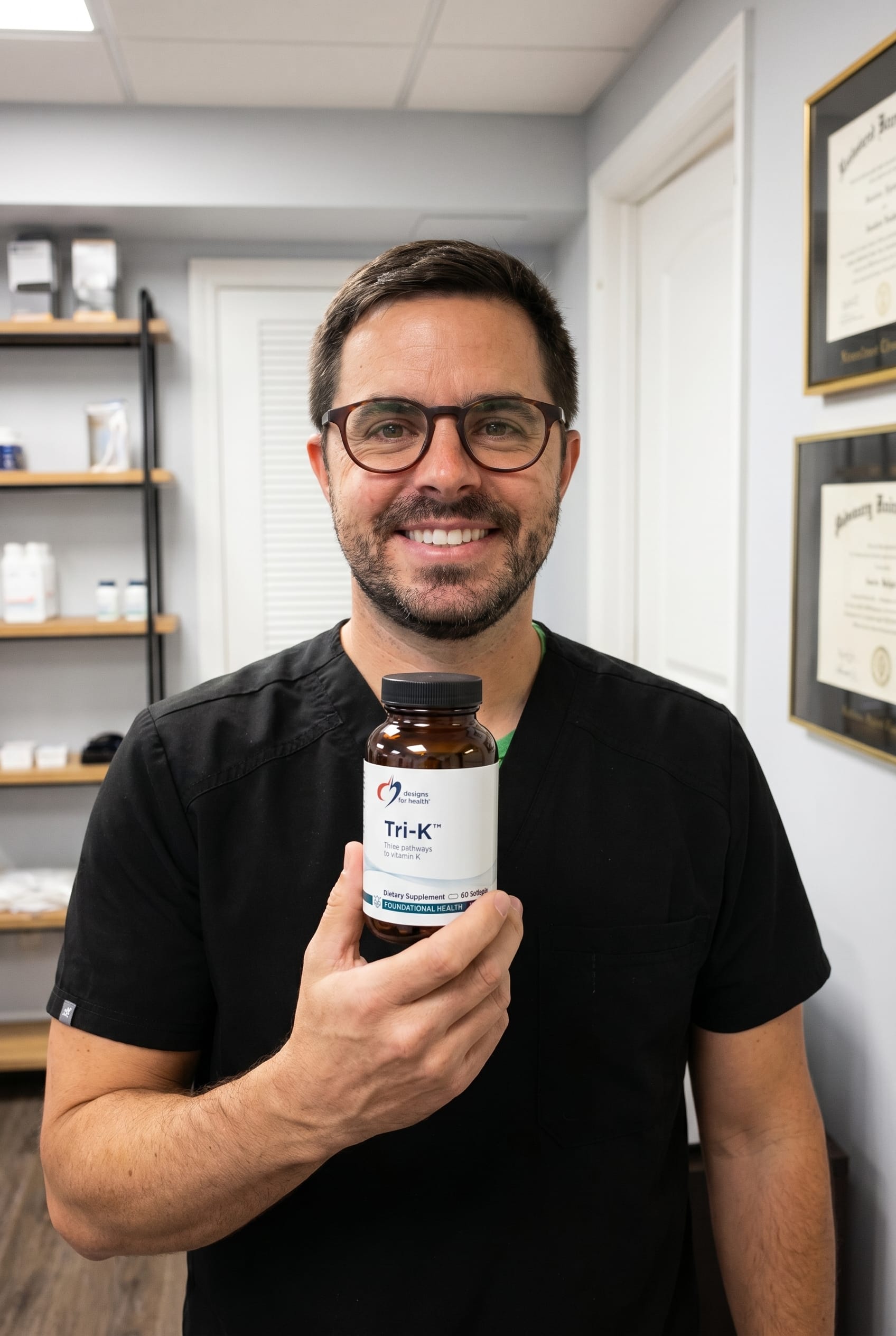
A patient in her early sixties came to me after a bone-density scan showed she was losing ground, heading toward osteoporosis. She was already taking calcium and vitamin D, as most people in her situation are told to, and she was doing weight-bearing exercise. She wanted to know whether there was anything else, beyond the usual calcium-and-D advice, that could actually help get the calcium into her bones where it belonged.
Her question was sharper than she realized, because it points to a piece of the bone puzzle that calcium and vitamin D alone do not address. Taking calcium ensures the raw material is available, and vitamin D helps you absorb it from the gut, but neither one tells the calcium where to go. That traffic-direction job belongs largely to vitamin K, an underappreciated nutrient that activates the proteins responsible for steering calcium into bone and keeping it out of soft tissue like your arteries. I added Designs for Health Tri-K to her routine.
What makes this product a thoughtful choice is in the name: it supplies three forms of vitamin K rather than one. It combines vitamin K1 with both major forms of vitamin K2, MK-4 and MK-7, plus GG-Gold, a compound that helps your body make its own K2. That broad coverage matters because the different forms behave differently in the body. Alongside her calcium, D, and exercise, this rounded out the bone-support picture. Vitamin K is not a quick-fix and bone health is a long game, but it addresses a genuine gap that calcium and D leave open.
Quick verdict: Designs for Health Tri-K fills a real gap in the standard bone-health routine: it supplies three forms of vitamin K, K1, K2 as MK-4 and MK-7, plus GG-Gold, to activate the proteins that steer calcium into bone and away from arteries.
Order Tri-K →What this product is actually doing
Vitamin K is best known for blood clotting, but its role in bone and cardiovascular health is where the interesting story lies. Vitamin K is required to activate certain proteins, by adding a chemical group to them in a process called carboxylation. Two of these proteins matter enormously here: osteocalcin, which binds calcium into the bone matrix, and matrix Gla protein, which helps keep calcium out of your arteries and other soft tissues.
Without enough vitamin K, these proteins stay inactive, and calcium is not properly directed. You can take all the calcium and vitamin D you want, but if the vitamin-K-dependent traffic controllers are switched off, the calcium is less likely to end up in bone and more likely to deposit where you do not want it. This is why vitamin K is increasingly seen as a key partner to calcium and D for bone health, and why it has earned its place in a serious bone-support routine.
Tri-K delivers all three relevant forms. Vitamin K1 (phytonadione) is the form most involved in clotting and is plentiful in leafy greens. Vitamin K2 comes in two key subtypes: MK-4, which acts quickly and is the form most studied for bone, and MK-7, which is longer-lasting in the bloodstream. The added GG-Gold, a patented form of geranylgeraniol, gives the body a building block to produce its own MK-4. Covering K1, MK-4, and MK-7 together is the logic behind the "Tri" in Tri-K.
What is in Tri-K
Each softgel delivers 2,000 mcg of vitamin K1 (as phytonadione), 500 mcg of vitamin K2 as MK-4, and 50 mcg of vitamin K2 as MK-7, plus 17.5 mg of GG-Gold geranylgeraniol. The softgel base uses medium-chain triglycerides, which helps with the absorption of these fat-soluble vitamins. The recommended use is one softgel twice per day with a meal, or as directed by your practitioner.
I appreciate that this is a high-potency, multi-form vitamin K rather than a token amount of a single type. Because the forms differ in how fast they act and how long they last, having all three covers the bases better than a product built around just one of them.
Set Up Autoship for Tri-K
If you take this regularly, set up DFH's Autoship and you get an extra discount on top of practitioner pricing, plus free shipping every time. Cancel or change the schedule any time. Set it and forget it.
Start Autoship →Who this is for
Tri-K fits people focused on bone health, especially those with declining bone density or a family history of osteoporosis, like my patient, and anyone already taking calcium and vitamin D who wants to complete the picture by making sure that calcium is properly directed. Because vitamin K2 also supports arterial health by keeping calcium out of the vessel walls, it appeals to people thinking about both bone and cardiovascular wellness.
The cautions here are specific and important. Vitamin K directly affects blood clotting, so if you take the blood thinner warfarin (Coumadin), you must not start vitamin K without your prescriber's involvement, because it can interfere with the medication. People on other anticoagulants should also check first. Otherwise vitamin K is well tolerated, but as with anything in pregnancy, breastfeeding, or alongside medication, a quick check with your provider is wise.
How to use it
One softgel twice daily with meals, since vitamin K is fat-soluble and absorbs best with food. It pairs naturally with calcium, vitamin D, and magnesium as part of a complete bone-support stack, and works best alongside weight-bearing and resistance exercise, which remain the most powerful drivers of bone strength. Like all bone interventions, judge it over the long term, ideally with periodic bone-density monitoring, not over weeks.
Bottom line
Designs for Health Tri-K fills a real gap in the standard bone-health routine: it supplies three forms of vitamin K, K1, K2 as MK-4 and MK-7, plus GG-Gold, to activate the proteins that steer calcium into bone and away from arteries. For people working on bone density who are already doing calcium, vitamin D, and exercise, it completes the picture in a way calcium and D alone cannot. The one firm caution is warfarin: if you take it, do not start vitamin K without your prescriber. Otherwise, it is a sensible, well-formulated piece of a long-term bone strategy.
Always check with a healthcare provider before starting vitamin K, especially if you take warfarin or another anticoagulant medication.
← See all bones, joints and muscles reviews by Dr. Bell
Ready to try Tri-K?
It is one I trust enough to use with my own patients and order for my family. Through my DFH store you get the authentic, direct-from-manufacturer product with practitioner pricing applied automatically at checkout.
Order Tri-K →Authentic, direct from Designs for Health · practitioner pricing · no third-party counterfeits
About the Author: Dr. Bell
Dr. Bell is a chiropractor and holistic wellness practitioner at Dr. Bell Health. He writes plain-language reviews of Designs for Health supplements based on years of clinical experience. Read more about Dr. Bell.