L-Glutamine Review by Designs for Health - Dr. Bell
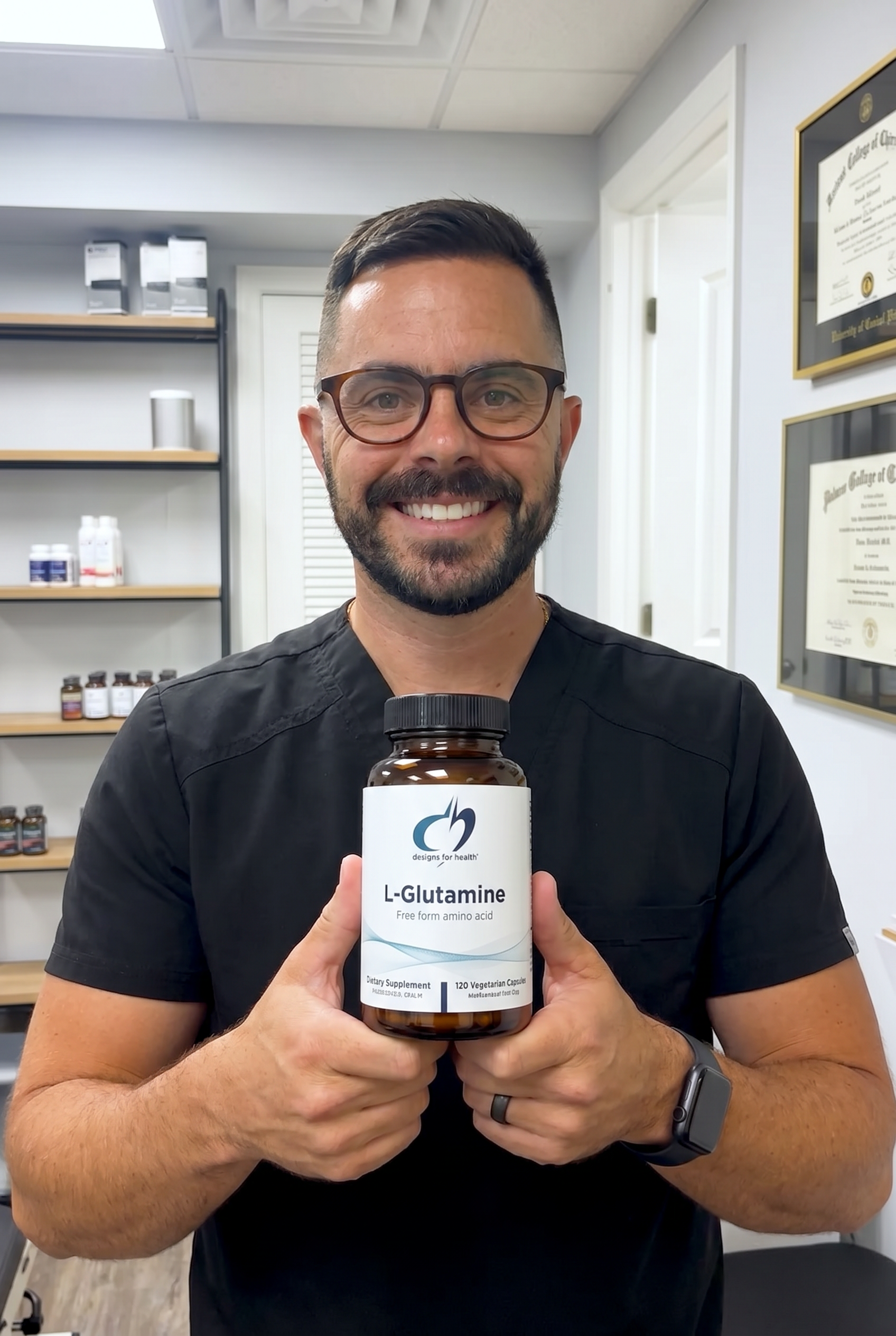
Designs for Health L-Glutamine review by Dr. Bell. 850 mg free-form L-glutamine per capsule for gut-lining repair, leaky gut, IBS, and recovery. Dosing, who benefits, side effects, and when I reach for the powder instead.

A 41-year-old patient came to me frustrated with a gut that had never quite recovered after a rough year. She had been through a course of strong antibiotics, a stretch of high stress, and too many months of grab-and-go meals, and now she was dealing with bloating, irregular stools, and a stomach that felt reactive to foods that had never bothered her before. Her labs were unremarkable and her physician had told her things looked structurally fine. She wanted to know if there was something foundational she could give her gut to help it repair, rather than just chasing symptoms.
This is one of the most common pictures I see, and one of the nutrients I think about first is glutamine. Glutamine is the single most abundant amino acid in the body, and it happens to be the preferred fuel source for the cells that line the small intestine. When the gut is under stress, demand for glutamine can outstrip what the body easily supplies, and giving the intestinal lining its preferred fuel is a simple, well-tolerated way to support repair. I started her on L-Glutamine.
What makes the Designs for Health version easy to recommend is that it is exactly what it should be: pure, free-form L-glutamine with almost nothing else in the capsule. Over the following weeks her bloating eased and her stools became more predictable. Glutamine is not a cure for a damaged gut, and it does not replace figuring out what is driving the problem, but as foundational support for the intestinal lining it is one of my most-used and most boring-in-a-good-way tools. This is the clean, no-frills way to get it.
Quick verdict: Designs for Health L-Glutamine is the clean, free-form glutamine I reach for when a gut lining needs foundational support after antibiotics, illness, or a stressful stretch.
Order L-Glutamine →What this product is actually doing
The cells that line your small intestine turn over fast, and they run largely on glutamine. It is their primary metabolic fuel, the way glucose fuels most other cells. When you are healthy and well fed, your body makes plenty of glutamine on its own, which is why it is called a conditionally essential amino acid: essential only when demand spikes. Illness, surgery, hard training, prolonged stress, and gut disruption all raise that demand.
Supplemental glutamine is used to give the intestinal lining a generous supply of its preferred fuel so the cells can do their normal job of maintaining a healthy, selectively permeable barrier. That barrier is what people are pointing at when they use the loose term leaky gut: the idea that the tight junctions between intestinal cells are not sealing the way they should. Glutamine is one of the better-studied nutrients for supporting the integrity of that lining.
It is also used outside the gut for general recovery support, since the immune system and rapidly dividing cells draw on glutamine too. Designs for Health L-Glutamine delivers it in the free-form, single-amino-acid version your body can use directly, without the protein digestion step. The capsule is built around that one job rather than buried in a multi-ingredient blend.
What is in L-Glutamine
The formula is about as simple as a supplement gets, which is the point.
- L-Glutamine (free-form), 850 mg per capsule (the pure amino acid, ready to be used directly)
- One capsule per serving (easy to scale up under a provider's guidance)
- Minimal other ingredients (cellulose capsule and a small amount of vegetable stearate, nothing else)
- Free of gluten, dairy, soy, and GMOs (clean enough for most sensitive guts)
The defining feature here is purity. There are no flavors, fillers, or extra actives competing for space. That matters for a gut-repair nutrient, because the people who need it most are often the people reacting to additives in other products. If you would rather take it as a drink, Designs for Health also makes a powder that delivers a larger 3,000 mg dose per scoop, which is the form I reach for when someone needs a higher daily amount. The capsules are the convenient, travel-friendly way to take a steady, moderate dose.
Set Up Autoship for L-Glutamine
If you take this regularly, set up DFH's Autoship and you get an extra discount on top of practitioner pricing, plus free shipping every time. Cancel or change the schedule any time. Set it and forget it.
Start Autoship →Who I reach for it with
I think about glutamine for people whose gut lining has been stressed: after a course of antibiotics, during recovery from a stomach illness, or for someone with ongoing bloating and irregularity who is also doing the foundational work of eating real food and managing stress. I also keep it in mind for hard-training athletes and people recovering from surgery or illness, where overall demand for the amino acid runs high.
How I use it is straightforward. A common starting point is one to a few capsules a day, often away from food, with the powder reserved for when someone needs a larger dose. I treat it as a defined support phase of several weeks alongside the real drivers of gut health, not necessarily a forever supplement. The body makes its own glutamine, so the goal is to cover the gap while the lining recovers, then reassess.
What I do not love about it
My honest caution is that glutamine is support, not a diagnosis. Persistent bloating, pain, blood in the stool, unexplained weight loss, or symptoms that drag on deserve a real workup, not months of self-directed amino acids. Glutamine can make a stressed gut more comfortable while masking a problem that needs actual investigation, so I want the underlying cause looked at, not just papered over.
There are also specific people who should be careful. Anyone with significant liver or kidney disease should only use glutamine under medical supervision, because those organs handle nitrogen and amino acid metabolism. People with a history of seizures or those on medications affected by glutamate pathways should check with their physician first. And because glutamine can be used by some tumors, anyone with active cancer should not start it without their oncologist's input.
Finally, I set expectations. Glutamine is foundational and quiet. It is not going to produce a dramatic overnight change, and it works best as one piece of a bigger plan that includes the food, sleep, and stress work that actually move the needle on gut health. For the right person in a repair phase, though, it is one of the simplest, best-tolerated tools I have.
For background, see the PMC review on glutamine and intestinal barrier function, the NIH Office of Dietary Supplements, and the NIH NIDDK overview of digestive diseases.
Bottom line
Designs for Health L-Glutamine is the clean, free-form glutamine I reach for when a gut lining needs foundational support after antibiotics, illness, or a stressful stretch. Each capsule delivers 850 mg of the pure amino acid with essentially no fillers, and the powder is there when someone needs a bigger dose. Use it as a defined support phase at the label dose, alongside the real work of eating well, sleeping, and managing stress.
Always check with a healthcare provider before starting any new supplement, especially if you have liver or kidney disease, a seizure history, active cancer, or are pregnant or breastfeeding.
← See all gut health reviews by Dr. Bell
Ready to try L-Glutamine?
It is one I trust enough to use with my own patients and order for my family. Through my DFH store you get the authentic, direct-from-manufacturer product with practitioner pricing applied automatically at checkout.
Order L-Glutamine →Authentic, direct from Designs for Health · practitioner pricing · no third-party counterfeits
About the Author: Dr. Bell
Dr. Bell is a chiropractor and holistic wellness practitioner at Dr. Bell Health. He writes plain-language reviews of Designs for Health supplements based on years of clinical experience. Read more about Dr. Bell.