Astaxanthin Review by Designs for Health - Dr. Bell
Designs for Health Astaxanthin review by Dr. Bell. 6 mg natural AstaREAL astaxanthin from algae, a powerful antioxidant for skin, eyes, and recovery. Dosing, who benefits, why to take it with fat, and honest limits.

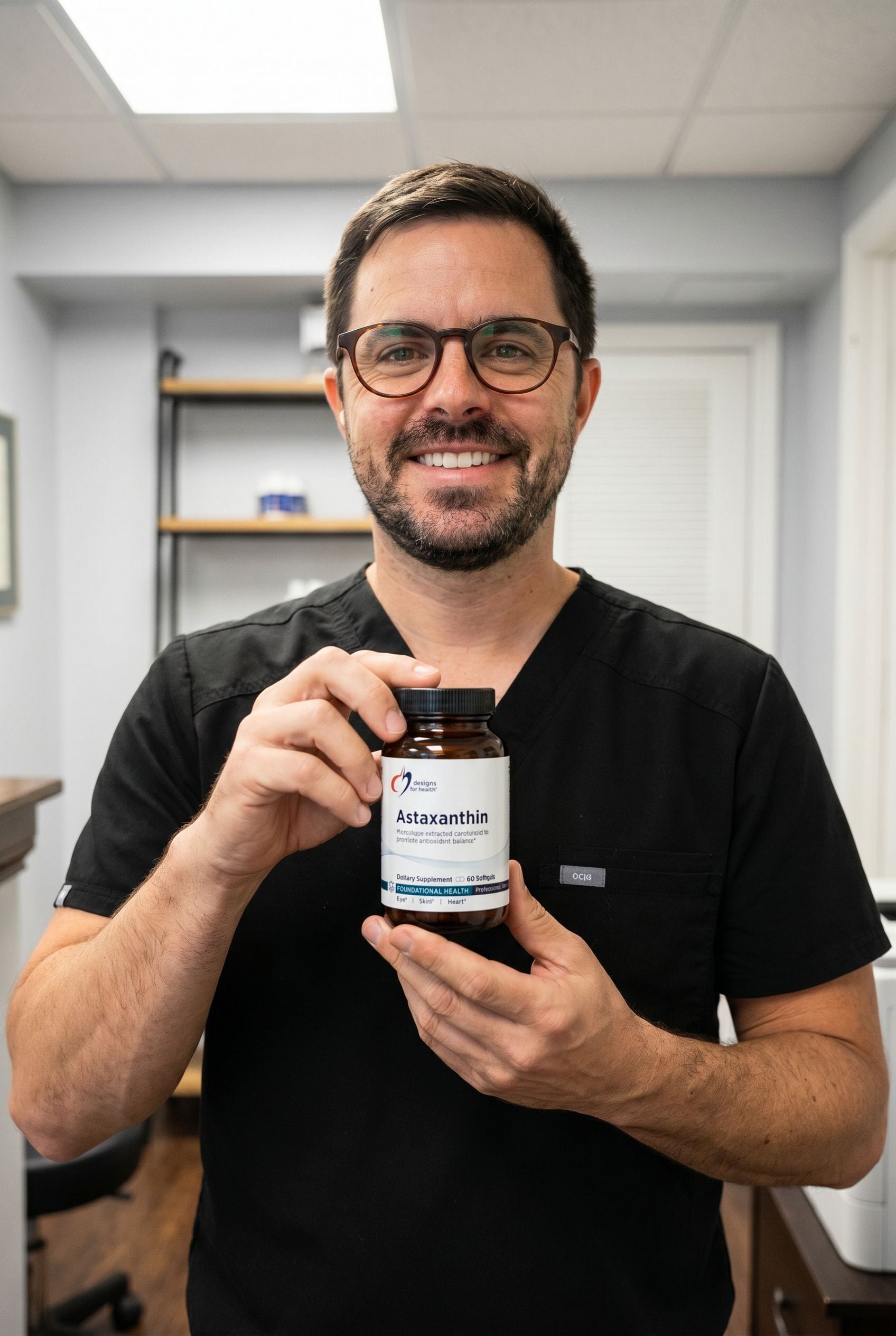
A 54-year-old patient, an avid outdoor cyclist, came to me asking about antioxidants, but he was skeptical. He had read that most antioxidant supplements are overhyped and wanted to know if any were actually worth taking. His specific interests were practical: supporting his skin against years of sun exposure, keeping his eyes comfortable on long rides, and recovering a little better from hard training. He had come across astaxanthin and wanted an honest read on whether it lived up to the marketing.
I appreciated the skepticism, because he was right that a lot of antioxidant supplements underdeliver. Astaxanthin, though, is one I find genuinely interesting. It is a reddish carotenoid pigment, the compound that makes salmon and shrimp pink, produced by a microalgae that uses it to survive intense sunlight and stress. It is a notably strong antioxidant with a structure that lets it work throughout the cell membrane, and it has a small but real body of research for skin, eye, and recovery support. I started him on Astaxanthin.
What makes the Designs for Health version easy to recommend is that it uses natural astaxanthin from algae, the AstaREAL form used in much of the research, at a sensible 6 mg dose. He took it with a meal and used it as part of, not instead of, sunscreen and sunglasses. Astaxanthin is supportive nutrition, not a sunscreen or a medication, but as a well-tolerated antioxidant with a real mechanism it is one of the carotenoids I am happy to point to. This is a clean way to get it.
Quick verdict: Designs for Health Astaxanthin is the natural, algae-sourced antioxidant I reach for when someone wants skin, eye, and recovery support from a carotenoid with a real mechanism.
Order Astaxanthin →What this product is actually doing
Astaxanthin is a carotenoid, the same family as beta-carotene and lutein, produced by the microalgae Haematococcus pluvialis. The algae makes it as a survival pigment to protect itself from intense light and oxidative stress, and that is essentially the property people are after when they take it: it is a potent antioxidant that helps neutralize the reactive molecules involved in everyday cellular wear and tear.
What sets it apart structurally is that it can position itself across the full width of a cell membrane, letting it quench free radicals at both the inner and outer surfaces. Practically, the research that interests me most is around skin, where it has been studied for supporting resilience against UV-related stress and skin quality, and around eye comfort and exercise recovery, where antioxidant support has a plausible role. None of this is dramatic, but it is coherent.
Designs for Health Astaxanthin delivers the natural, algae-sourced form rather than a synthetic version, in a softgel with oil because astaxanthin is fat-soluble and absorbs far better alongside fat. The product is built around delivering a meaningful, research-relevant dose of the natural pigment.
What is in Astaxanthin
This is a focused, single-active softgel.
- Natural astaxanthin (AstaREAL), 6 mg from Haematococcus pluvialis algae extract
- Softgel with oil (so the fat-soluble pigment actually absorbs)
- One softgel per serving, taken with a meal containing some fat
- Free of gluten, dairy, and soy (note: the softgel uses bovine gelatin, so it is not vegetarian)
The defining feature is that this is the natural, algae-derived astaxanthin used in much of the research, not a cheaper synthetic. The 6 mg dose is a sensible everyday amount, and delivering it in an oil-based softgel solves the absorption problem that plagues fat-soluble nutrients in dry capsules. Take it with a meal that has some fat and you will get far more out of it.
Astaxanthin Direct from the Manufacturer
Most supplements are heat- and humidity-sensitive, and potency drops fast in a third-party warehouse. Buying through my DFH store means your bottle goes from their climate-controlled facility straight to your door, at practitioner pricing.
Order Astaxanthin →Who I reach for it with
I think about astaxanthin for people interested in skin support against everyday oxidative and sun-related stress, for those who want eye-comfort support, and for active people looking for a little help with exercise recovery. It is also reasonable as a general antioxidant for someone building a healthy-aging routine who wants a carotenoid with a real mechanism behind it.
How I use it is simple: one softgel a day with a fat-containing meal, given consistent time. I am clear that it complements, not replaces, the things that actually protect skin and eyes, namely sunscreen, sunglasses, and sensible sun habits. As with most antioxidants, the effect is supportive and gradual rather than something you feel immediately.
What I do not love about it
My honest framing is that the human research, while promising, is still modest in size. Astaxanthin has a strong antioxidant profile and encouraging studies for skin and recovery, but I would not promise visible results, and I am wary of marketing that treats it as a miracle anti-aging pill. I present it as a reasonable, low-risk antioxidant, not a proven treatment for any condition.
A practical caution: it is fat-soluble, so taking it without food wastes most of it, and more is not automatically better with carotenoids. It is also worth knowing the softgel is gelatin-based, so it does not suit vegetarians, who would need a different product. People on blood-pressure or blood-thinning medications should check with their physician, since antioxidants can occasionally interact, and pregnant or breastfeeding women should clear it first.
Finally, expectations: this is a quiet, supportive nutrient. It is not going to replace your sunscreen or reverse sun damage, and any benefit builds slowly. For someone who wants a well-made, natural antioxidant as part of a broader healthy-aging routine, though, it is one of the more interesting carotenoids available.
For background, see the PMC review on astaxanthin and skin health, the NIH Office of Dietary Supplements, and the NIH NCCIH overview of antioxidants.
Bottom line
Designs for Health Astaxanthin is the natural, algae-sourced antioxidant I reach for when someone wants skin, eye, and recovery support from a carotenoid with a real mechanism. It delivers 6 mg of the AstaREAL form in an oil softgel for absorption. Take one a day with a fat-containing meal, give it time, and use it alongside, not instead of, sun protection.
Always check with a healthcare provider before starting any new supplement, especially if you take blood-pressure or blood-thinning medications or are pregnant or breastfeeding.
← See all healthy aging reviews by Dr. Bell
Ready to try Astaxanthin?
It is one I trust enough to use with my own patients and order for my family. Through my DFH store you get the authentic, direct-from-manufacturer product with practitioner pricing applied automatically at checkout.
Order Astaxanthin →Authentic, direct from Designs for Health · practitioner pricing · no third-party counterfeits
About the Author: Dr. Bell
Dr. Bell is a chiropractor and holistic wellness practitioner at Dr. Bell Health. He writes plain-language reviews of Designs for Health supplements based on years of clinical experience. Read more about Dr. Bell.